

Iran Risk Threatens The Everything Rally
The Trump administration’s goal of regime change for Iran suggests a prolonged war… Airstrikes alone are unlikely to topple the regime’s praetorian guard that’s oversees Iran’s leading military force with sprawling economic interests to finance its operations…“At th…
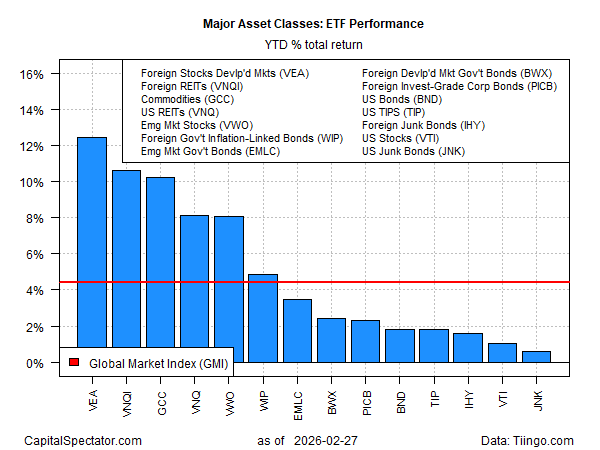
All the major asset classes are posting year-to-date gains, as of Friday’s close. But a lot can happen over one weekend.
The US-Israel military strike on Iran is ongoing and appears set to continue for days, possibly weeks. No one knows how this will play out in markets beyond the immediate future, but it’s reasonable to assume that the bullish sentiment, which was already showing signs of fatigue in some corners, could become collateral damage the Middle East conflict.
Foreign stocks and commodities are the performance leaders in 2026 through Friday’s close (Feb. 27), based on a set of ETFs. But last week’s assumptions about the future suddenly look like ancient history.

The crucial question: How vulnerable is the world economy? The short answer: blowback risk will increase the longer the war lasts. At the moment, the odds appear low for a quick cessation of hostilities as the war widens across the Middle East, which include Iran’s attack on oil infrastructure in Saudi Arabia.
“The attack on Saudi Arabia’s Ras Tanura refinery marks a significant escalation, with Gulf energy infrastructure now squarely in Iran’s sights,” said Torbjorn Soltvedt, an analyst at the risk intelligence company Verisk Maplecroft. “An extended period of uncertainty lies ahead as Iran seeks to impose a heavy economic cost by putting tankers, regional energy infrastructure, trade routes and U.S. security partners in the crosshairs.”
The economic costs for the global economy could be significant if the conflict lingers and oil prices stay elevated. Roughly 31% of all seaborne oil flowed through the Strait of Hormuz in 2025, according to analysis by Kpler, a data analytics firm. Those flows are vulnerable due to Iran’s strategic location, which allows it to disrupt if not halt shipping through the waterway.
“The implications of this conflict for the world economy depend on the flow of oil and gas through the Strait of Hormuz,” said Norbert Rücker, head of economics at Julius Baer. “The most feared scenario is not its closure, but serious damage to the region’s key oil and gas infrastructure.”
Kpler advises: “Any meaningful closure – or even a sustained de facto closure driven by insurance withdrawal – would trigger supply shocks across multiple commodity classes simultaneously.”
How long will the conflict last? No one knows, but on Sunday President Trump said the military operation could “take four weeks or less.”
Unsurprisingly, oil is rising today. The international Brent benchmark is near $78 a barrel this morning, the highest in over a year.

The Trump administration’s goal of regime change for Iran suggests a prolonged war. “I call upon all Iranian patriots who yearn for freedom to seize this moment … and take back your country,” Trump said on Sunday.
Regime change won’t be easy. Although Iran’s supreme leader, Ayatollah Ali Khamenei, was killed by airstrikes on Saturday, the country’s paramilitary Revolutionary Guard remains a powerful force and has likely prepared for a long struggle following a series of previous attacks on the country by the US and Israel. Airstrikes alone are unlikely to topple the regime’s praetorian guard that’s oversees Iran’s leading military force with sprawling economic interests to finance its operations.
“At the end of the day, once US and Israeli strikes stop, if the Iranian people come out, their success in promoting the end of the regime will depend on the rank and file standing aside or aligning with them,” said Jonathan Panikoff, a former US intelligence official who is now at the Atlantic Council think tank in Washington. “Otherwise, the remnants of the regime, those with the weapons, are likely to use them to keep power.”

Regime change in Iran is currently estimated as moderately unlikely, with a 42% chance, according to the latest betting data at Polymarket. The implication, the prospects appear weak for a quick end to the conflict until one side blinks first.
Looking beyond the next several weeks changes the calculus, according to Sanam Vakil, director of the Middle East and North Africa Program at Chatham House, a London-based research group. “The Islamic Republic as we know it will not survive this,” he predicts.
If so, the main issue is what replaces the current regime and does the change promote stability or chaos in Iran and across the Middle East?
Is Recession Risk Rising? Monitor the outlook with a subscription to:
The US Business Cycle Risk Report
Author: James Picerno