

Energy Prices Are Soaring. How Long Will It Last?
The Iran war has slowed oil exports through the Strait of Hormuz to a crawl, leading to the expected result: a surge in energy prices… The bigger, more important question: How long will the spike last? The stakes surrounding the answer are high since the path of energy prices could influence an ar…
The Iran war has slowed oil exports through the Strait of Hormuz to a crawl, leading to the expected result: a surge in energy prices. So far, so expected. The bigger, more important question: How long will the spike last? The stakes surrounding the answer are high since the path of energy prices could influence an array of macro factors, including economic activity, interest rates and monetary policy.
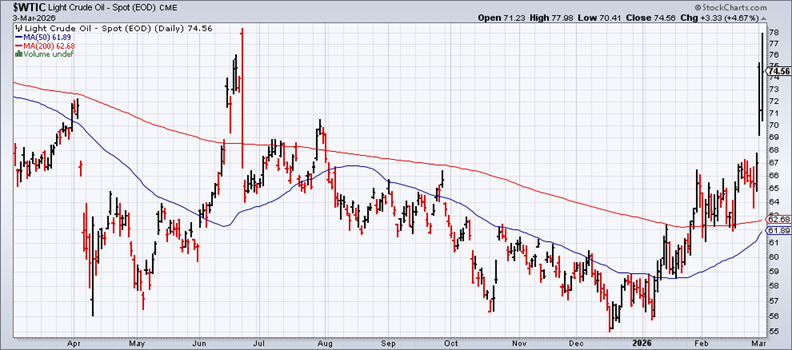
The US crude oil benchmark (West Texas Intermediate) has increased sharply in trading so far this week, jumping nearly $75 a barrel by the close of trading yesterday (Mar. 3). Year to date, WTI is up 30%, and spot gasoline in the US is trading 44% above its 2025 close.

Crude Risk
The optimistic spin is that once the war is over, energy prices will quickly return to the subdued levels that prevailed before the Iran war dominated trading.
“The primary near-term driver for oil prices remains the US-Iran conflict,” said OANDA senior market analyst Kelvin Wong. “At this stage, only clear signs of de-escalation could mitigate or reverse the current bullish trend for WTI, and such signals are currently lacking.”
The key choke point is the Strait of Hormuz, which is a crucial trade route for energy. A fifth or more of the seaborne oil exports flow through this narrow channel, whose shores include Iran and Saudi Arabia.
The war has dramatically reduced shipping through the strait. “It’s a de facto closure,” said Dan Pickering, chief investment officer of Pickering Energy Partners, a Houston financial services firm. “You’ve got a significant number of vessels on either side of the strait, but no one is willing to go through.”
Shipping Flow

Attacks on shipping have become “a huge deterrent for all but a few shipping companies and charterers,” said Martin Kelly, head of advisory at maritime intelligence group EOS Risk.
The White House is trying to counter the risk, announcing on Tuesday that the US will “immediately” offer “political risk insurance and guarantees.” President Trump also wrote on social media that “If necessary, the United States Navy will begin escorting tankers through the Strait of Hormuz, as soon as possible.”
The conflict rages on, with few signs of an end game in the immediate future. When it does end, oil shipments could quickly rebound, acting as a downward force on prices as supply rebounds. But that scenario will be threatened if Iran extends and expands attacks on energy infrastructure in the Gulf region. In that case, the squeeze on exports could linger for months.
A key oil refinery in Saudi Arabia and two facilities in Qatar were attacked earlier in the week.
“Gulf energy infrastructure [is] now squarely in Iran’s sights,” said Torbjorn Soltvedt, an analyst at the risk intelligence company Verisk Maplecroft. “An extended period of uncertainty lies ahead as Iran seeks to impose a heavy economic cost by putting tankers, regional energy infrastructure, trade routes and US security partners in the crosshairs.”
Repairing damaged pipelines and refining operations won’t happen overnight. An additional risk: attacks on Saudi Arabia oil infrastructure could trigger retaliatory attacks, which would threaten an escalation in the war.
Asia is especially vulnerable to reduced exports, advises S&P Global: “This is because the majority of exports from the region through the strait are to Asia, namely China and India.”

US Production Will Help Soften The Blow
The US, by comparison, is less vulnerable, thanks to a dramatic increase in domestic oil production in recent years, driven development of shale sources. America energy output has soared, according to US government data. But the odds are reportedly low that American producers will quickly act to increase supply to offset effects of the war in an effort to keep energy prices low.
The path ahead is as uncertain as it is risky for the global economy. The potential for higher inflation, slower growth, and higher energy prices for an extended period will complicate decisions about monetary policy for central banks and increase the possibility of policy errors.
The path to greater pain, however, is clear. “If this war does continue as long as US President Donald Trump suggests – three or four weeks – there will definitely be a situation where the price of oil will skyrocket which will have adverse impacts on the global economy and more locally for the US,” predicts Arang Keshavarzian, professor of Middle Eastern and Islamic Studies at New York University.

Author: James Picerno