

Prolonged Iran Conflict Starting To Raise Specter of Stagflation
“If the conflict is prolonged, financial amplifications could magnify the macroeconomic impacts,” said Hyun Song Shin, head of the economics and monetary department at the Bank for International Settlements… “A spike in interest rates could put pressure on rich asset price valuations… Ris…
Estimating the timeline for the end game for the war in Iran remains a slippery task. Gaming out the costs, by contrast, is relatively straightforward. Each day the war continues, the outlook turns a bit murkier, and the risk ticks higher for economic harm.
No one doubts that an end to the fighting would immediately relieve stress for the global economy. An end to hostilities would quickly lead to a resumption of energy shipments through the Strait of Hormuz, which represents roughly one-fifth of the world’s crude oil consumption. But as the war drags on, the potential for collateral damage that lingers is mounting.
Some analysts are starting to consider the effects of a prolonged war. “If the conflict is prolonged, financial amplifications could magnify the macroeconomic impacts,” said Hyun Song Shin, head of the economics and monetary department at the Bank for International Settlements. “A spike in interest rates could put pressure on rich asset price valuations. Rising financing costs for governments and the need to issue more debt could undermine fiscal sustainability given already strained public finances in many countries.”
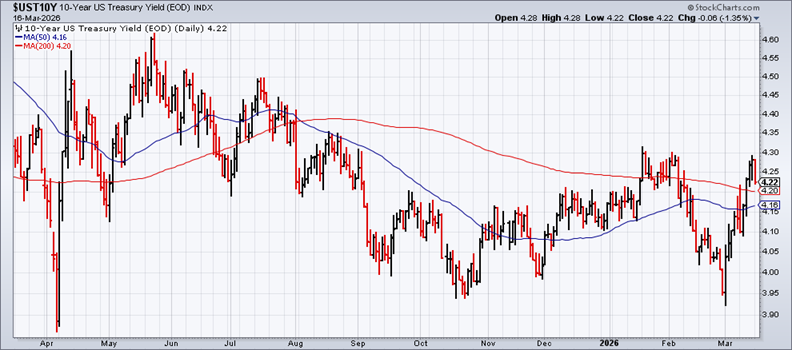
The bond market, however, remains calm, at least for now. The US 10-year Treasury yield, for example, has increased since the war started, but the benchmark rate continues to trade at a middling range relative to its history over the past year.

But an extended war is no longer considered beyond the pale, which is starting to motivate thinking about the implications.
“In my view, markets are underestimating the risk of a prolonged war,” said Frederic Schneider, a senior fellow at the Middle East Council on Global Affairs. Pondering another month of war and ongoing increases in energy prices, he predicts the blowback for the global economy could be harsh. “The worst-case scenario would be an economic slump combined with an interest rate hike to curb inflation.”
The war’s effects are starting to move central banks to adjust monetary policy. Australia’s central bank today lifted its benchmark policy rate for a second straight time, raising it to their highest level in nearly a year. The Reserve Bank of Australia cited the war as a factor in its decision:
The conflict in the Middle East has resulted in sharply higher fuel prices, which, if sustained, will add to inflation. Short-term measures of inflation expectations have already risen. As a result, the Board judged that there is a material risk that inflation will remain above target for longer than previously anticipated.
The Federal Reserve, by contrast, is expected to keep rates steady for the foreseeable future. Fed funds futures are pricing in no change to the Fed’s target rate for the next four meetings through July, and a slight possibility of a rate cut in September.
But with the war continuing, and the potential for surprises front and center, forecasting interest rates, inflation and economic activity is becoming increasingly challenging these days.
By some accounts, a return to “normal” will take time, which raises the possibility that stagflation risk could persist. Even if the war ended tomorrow, “lingering geopolitical uncertainty and the inevitable delays in getting shut-in oil wells back online could keep oil prices elevated for months,” advise analysts at the Chicago Council on Global Affairs.
Unfortunately, the odds still appear low for an imminent end to the fighting, which is still putting upward pressure on oil prices.
“Mixed messages are coming from the Trump administration on the war’s duration, as the market focuses more on the actions on the ground that remain escalatory,” said Saul Kavonic, head of energy research at MST Marquee.
Author: James Picerno