

Steady Today, Uncertain Tomorrow: Iran War Tests US Resilience
The war in Iran is sending shockwaves across the globe, but the US economy has managed to stay remarkably steady so far… The war’s effect on economic activity for the January-through-March period will be limited, but the economy’s momentum, or lack thereof, in the start of the year will be cru…
The war in Iran is sending shockwaves across the globe, but the US economy has managed to stay remarkably steady so far. How long the relative calm lasts is unclear, and will likely be determined by the duration of the conflict.
Let’s start with the upcoming first-quarter GDP nowcast. The war’s effect on economic activity for the January-through-March period will be limited, but the economy’s momentum, or lack thereof, in the start of the year will be crucial because a tailwind of some degree will be helpful in minimizing the macro shock that may be brewing for Q2.
The good news: a moderate rebound is expected for Q1 growth following the weak increase in output in Q4. The Atlanta Fed’s current Q1 nowcast still reflects a 2.1% annualized rise in GDP. If correct, the economy will partially recover from Q4’s stall-speed 0.7% advance.
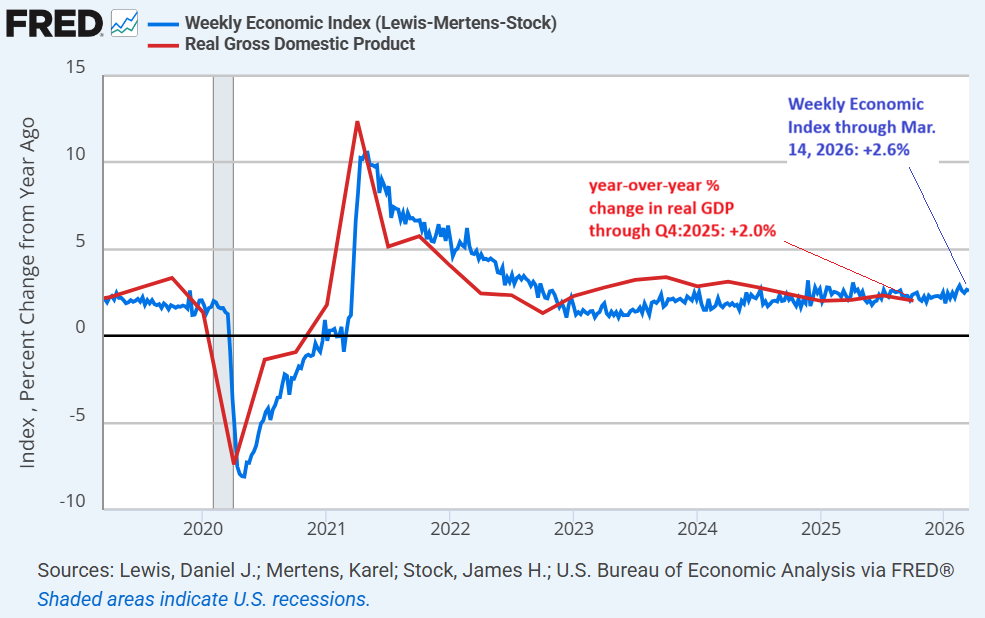
The Dallas Fed’s Weekly Economic Index (WEI) offers a more granular and current review, and on that score there’s no sign that the war has derailed the recent reacceleration of the trend. WEI’s current reading is 2.6% as of Mar. 14. Using this as a proxy for the year-over-year change in GDP suggests that economic activity is stable, and perhaps even strengthened through mid-March.

But these are still early days for assessing the war’s effects, for the US and the global economy. Three weeks into the conflict, the repercussions continue as the energy shock reverberates. Europe and Asia are more vulnerable, given their higher reliance on imported oil. The US, a net oil exporter, has a substantially higher level of immunity. But oil is priced globally. As I reported last week, “Oil is priced in a single worldwide marketplace, which means that shifts in supply, demand, and geopolitical risk spill across borders regardless of how much a country produces.”
Given the global aspect of pricing, it’s no surprise that the US crude oil benchmark (West Texas Intermediate) has risen sharply this year in line with the surge in the international benchmark (Brent).

Yet The Wall Street Journal’s new survey of economists highlights expectations for resiliency, at least so far: “Economists Don’t See a Recession Unless Oil Hits $138—and Stays There for Weeks.” WTI traded at roughly $95 a barrel on Thursday.
Predicting oil prices is challenging, to say the least, especially in the current environment. Presumably the war will end soon, but no one knows the timeline, except perhaps one man in the White House.
This much is obvious: the longer the attacks continue, the longer the energy infrastructure is degraded in the Gulf region, and the longer that oil and natural gas exports from the Middle East are blocked, the deeper the economic pain and the longer and slower the eventual recovery.
Surveying the disruption of exports through the Strait of Hormuz to date, Priyanka Sachdeva, senior market analyst at Phillip Nova, said: “The damage has been inflicted, and even if safe passage for tankers is somehow negotiated through Hormuz, reviving logistics fully fledged can take an awfully long time.”
Meantime, the risk of higher inflation and slower growth are likely creeping higher every day.
Writing on X yesterday, E.J. Antoni, chief economist at the Heritage Foundation, a conservative think-tank that’s closely aligned with President Trump, advised:
“If war is done in next few days, damage to energy infrastructure is minimal, and Iran lets ships transit strait unmolested, there’ll be minimal impact; but drag this on for months and destroy lots of infrastructure, then impact will be big; no one knows the future.”

Author: James Picerno