

Book Bits: 28 March 2026
By purchasing books through this site, you provide support for The Capital Spectator’s free content…● The Quantamental Revolution: Factor Investing in the Age of Machine Learning Milind Sharma Summary via publisher (Wiley) In The Quantamental Revolution: Factor Investing in the Age of Machi…
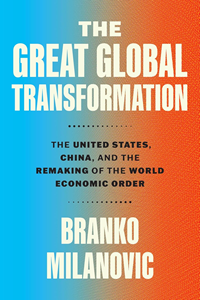
 ● The Great Global Transformation: The United States, China, and the Remaking of the World Economic Order
Branko Milanovic
Review via Compact
According to Milanović, our decaying neoliberal order is so globalized and over-extended that it has coiled back in on itself, leaving us to commodify even our own leisure time by becoming increasingly incapable of enjoying it if it is not shared and displayed through social media… he sees little prospect of “re-embedding” market institutions in renewed social democracies and welfare states. While he sees neoliberal globalization coming to an end, he expects this process to crumble back into what he calls “national market liberalism”: neoliberal institutions confined to nations in which the balance between state and market remains tilted in favor of market elites.
 ● The Quantamental Revolution: Factor Investing in the Age of Machine Learning
Milind Sharma
Summary via publisher (Wiley)
In The Quantamental Revolution: Factor Investing in the Age of Machine Learning, veteran quantitative investor and strategist, Milind Sharma, delivers a comprehensive discussion of factor investing, risk premia, smart betas, multi-factor models and the deployment of ML ensembles towards monetizing alpha in the hedge fund world. Sharma draws on 30 years of industry and academic experience to bring us up to date on the cutting edge of quantitative factor investing.
 ● The Insatiable Machine: How Capitalism Conquered the World
Trevor Jackson
Review via The New York Times
In 2003, the literary theorist Fredric Jameson wrote that it was “easier to imagine the end of the world than to imagine the end of capitalism.” Trevor Jackson seems to agree, but only to a point. In “The Insatiable Machine: How Capitalism Conquered the World,” Jackson says that the prevailing economic system has already gone a long way toward destroying our “finite planet.” He argues that if we don’t find a way to change course, the end of the world won’t be something we have to imagine; it will actually arrive.
 ● The Algorithm: The Hypergrowth Formula That Transformed Tesla, Lululemon, General Motors, and SpaceX
Jon McNeill
Review via ZD Net
The march to AI-driven technology development is hitting a wall — a wall of complexity. As AI increasingly becomes part of business, it is driving demand for well-designed infrastructure, resilient networks, and sophisticated software stacks that all demand human oversight and intervention.
That’s the word from Jon McNeill, CEO of DVx Ventures, former president of Tesla, and former chief operating officer of Lyft. McNeil is the author of a new book The Algorithm: The Hypergrowth Formula That Transformed Tesla, Lululemon, General Motors, and SpaceX. I recently had the opportunity to sit down with McNeill to discuss what IT professionals should consider and look for as they move into this new landscape.
 ● Expectations Matter: The New Causal Macroeconomics of Surveys and Experiments
Olivier Coibion and Yuriy Gorodnichenko
Summary via publisher (Princeton U. Press)
How do expectations about the future influence economic behavior? For decades, economists have known that beliefs play a central role—from how much households spend, to how firms set prices, to how central banks design policy. But figuring out exactly how expectations affect decisions has been one of the field’s most persistent empirical challenges. In this book, Olivier Coibion and Yuriy Gorodnichenko present a fresh empirical approach: using randomized controlled trials (RCTs) to study the causal impact of expectations. Drawing on more than a decade of their research, they show how targeted information treatments can generate experimental variation in beliefs—making it possible to measure how those beliefs influence real-world decisions. Along the way, they reassess the limits of the traditional rational expectations framework and offer a richer, evidence-based picture of how people form and act on their views about the economy.
Please note that the links to books above are affiliate links with Amazon.com and James Picerno (a.k.a. The Capital Spectator) earns money if you buy one of the titles listed. Also note that you will not pay extra for a book even though it generates revenue for The Capital Spectator. By purchasing books through this site, you provide support for The Capital Spectator’s free content. Thank you!
Author: James Picerno