
Fed Walks a Policy Tightrope as Iran Conflict Clouds the Outlook
For the near term, the least worst option is to sit tight and leave rates unchanged until the incoming data start to make a strong case for changing the monetary policy bias… Noting that keeping the Fed’s target rate steady for the near term “for quite some time” is her preference, “I can…
The Federal Reserve is steering through one of the most challenging policy environments in years as the war with Iran destabilizes global energy markets and raises uncertainty about inflation and economic activity. The spike in geopolitical volatility leaves policymakers navigating an exceptionally narrow path: tightening too aggressively risks tipping the economy into recession, while easing too soon could reignite inflation. For the near term, the least worst option is to sit tight and leave rates unchanged until the incoming data start to make a strong case for changing the monetary policy bias.
The Cleveland Federal Reserve president, Beth Hammock, underscored this point in an interview with AP on Monday. Noting that keeping the Fed’s target rate steady for the near term “for quite some time” is her preference, “I can foresee scenarios where we would need to reduce rates … if the labor market deteriorates significantly,” she added. “Or I could see where we might need to raise rates if inflation stays persistently above our target.”
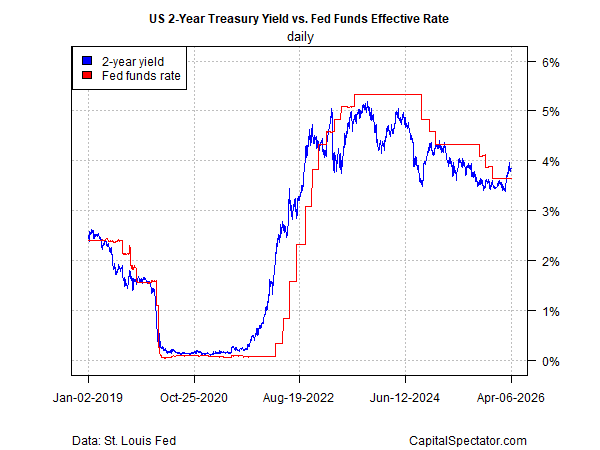
The Treasury market has recently recalibrated its outlook and is now firmly pricing in a higher probability of a rate hike in the near term after an extended run of dovish pricing. The policy-sensitive 2-year yield (3.84% as of Apr. 6) continues to trade above the median effective Fed funds rate (3.64%), marking a clear change in sentiment toward a hawkish bias for the first time since 2022.

The degree of future inflation risk remains debatable, as does the potential for a slowdown in economic growth. But the odds are widely perceived as higher for one or both sides of this coin.
“All roads now lead to higher prices and slower growth,” predicts IMF managing director Kristalina Georgieva. “We are in a world of elevated uncertainty,” she told Reuters yesterday, pointing to a variety of risk factors, including geopolitical tensions, technological advancements, climate shocks and demographic shifts. “All of this means that after we recover from this shock, we need to keep our eyes open for the next one.”
Current Fed policy is still modestly tight, based on a simple model using the unemployment rate and the year-over-year change in the headline Consumer Price Index. That gives the central bank space to take a wait-and-see approach and monitor incoming numbers.

Chicago Fed President Austan Goolsbee, however, suggests that a rate hike could be near. Asked to characterize the state of risk for the economic outlook using a four-color template, ranging from “the house is on fire” red to “everything is looking swell” green, he responded. “At least orange. Orange with a chance of meatballs; it hasn’t been great.”
The Treasury market is inclined to agree lately. But inflation and economic data arrive with a lag, and so the Fed will continue to wait to develop a clearer view of how the economy’s reacting to the war with Iran.
The challenge is not waiting too long, lest inflation and/or slower growth move too far ahead of policy, which would leave the Fed in the difficult position of trying to play catch-up. That was the case when the central bank was slow to raise rates when inflation spiked in 2021-2022, and so avoiding that mistake is very much a priority just a few years after that policy mistake.
At the same time, the risk of acting too early could make a bad situation worse, on either the inflation or growth fronts.
In the end, the Fed’s challenge is less about choosing the perfect policy setting and more about staying nimble in a world where the ground keeps shifting. The only certainty is that the next move—whenever it comes—will be made under conditions that are anything but certain.

Author: James Picerno