

Q1 GDP Poised for Rebound as Fragile Ceasefire Clouds Outlook
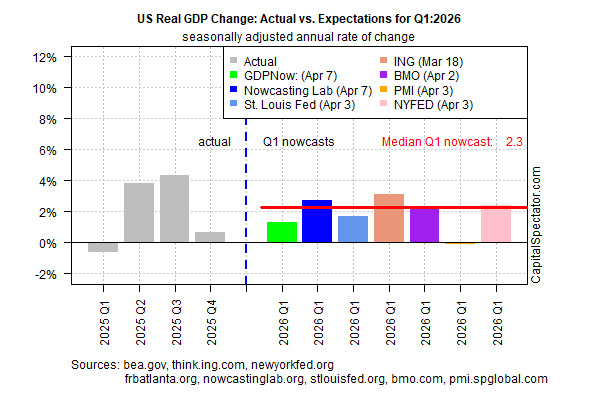
Meanwhile, the government’s initial estimate of Q1 GDP is expected to post a 2… The current reading estimates growth at 1…A survey-based estimate of GDP has also been revised lower recently…The softer GDPNow and PMI inputs have yet to affect the median estimate, but incoming…
US economic activity is still expected to rebound in the upcoming first-quarter GDP report scheduled for Apr. 30, but recovery from Q4’s stall-speed increase may face stronger headwinds in Q2 as the effects from the war with Iran reverberate in the months ahead.
A fragile ceasefire suggests the macro healing can begin, but the conflict’s consequences will take time to assess. Meanwhile, the government’s initial estimate of Q1 GDP is expected to post a 2.3% increase, based on the median nowcast compiled by CapitalSpectator.com from a range of sources. If correct, output in Q1 will recover from a weak 0.7% rise in Q4.

There are several caveats to consider for today’s update. For example, one of the inputs — the Atlanta Fed’s GDPNow model — has downgraded its Q1 nowcast in recent weeks. The current reading estimates growth at 1.3% (as of Apr. 7), down from 2.8% two weeks ago.
A survey-based estimate of GDP has also been revised lower recently. The S&P Global US Composite PMI was cut last week, aligning with a roughly flat performance for US economic activity in March.
“The PMI survey data show the US economy buckling under the strain of rising prices and intensifying uncertainty, as the war in the Middle East exacerbates existing concerns regarding other policy decisions in recent months, notably with respect to tariffs,” says Chris Williamson, chief business economist at S&P Global Market Intelligence. A key source of weakness is the services sector, which “has slipped into contraction for the first time since January 2023,” he reports.

The softer GDPNow and PMI inputs have yet to affect the median estimate, but incoming data between now and the Q1 report due on Apr. 30 are expected to trigger downside revisions.
The odds that a US recession has started or is imminent remain low, based on modeling updated weekly in The US Business Cycle Risk Report. But with the war’s effects still swirling, and uncertainty about the ceasefire, the near-term risks remain elevated.
Mark Zandi, chief economist at Moody’s, writes: recession risks are “uncomfortably high.”
Confidence will rise in the coming weeks for confirming, or rejecting, Zandi’s view. For now, one of the most important risk indicators is evolving in real time: the stability of the ceasefire.
Is Recession Risk Rising? Monitor the outlook with a subscription to:
The US Business Cycle Risk Report
Author: James Picerno