

Momentum Factor Roars As War Fears Fade On Wall Street
Wall Street analysts project that AI‑related capital spending will top $1 trillion by 2027…War? What war? The effects of the Middle East conflict continue to reverberate through the global economy, but for the strongest performers among US equity factors, the war has been little more than an af…
War? What war?
The effects of the Middle East conflict continue to reverberate through the global economy, but for the strongest performers among US equity factors, the war has been little more than an afterthought.
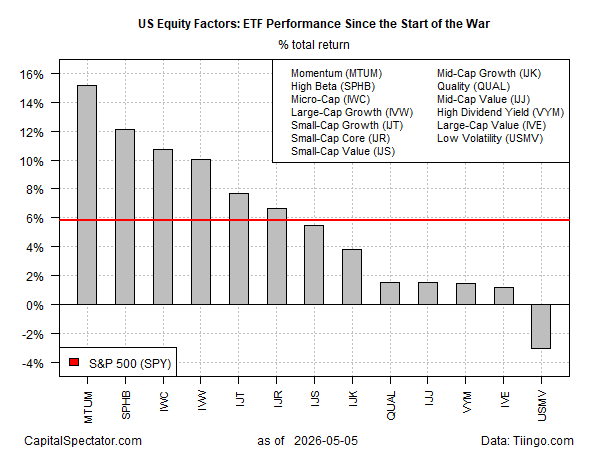
Momentum and high‑beta have rallied sharply since the war started and are outperforming the broad market by a wide margin, based on a set of ETFs through yesterday’s close (May 5). The iShares MSCI USA Momentum Factor ETF (MTUM) is the top performer, rallying more than 14% since the war began on Feb. 28 — far above the broad equity market’s 5.3% increase over that span, based on the SPDR S&P 500 ETF (SPY).
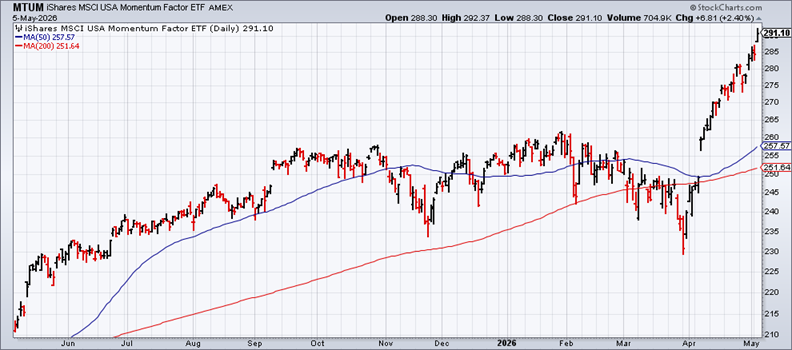
If anything, the war seems to have accelerated the risk‑on effect for MTUM, which closed at a record high yesterday. The momentum factor, in short, is running hot with bullish momentum.
In second place: high‑beta shares (SPHB), followed by micro‑cap stocks (IWC). Several factor ETFs are trailing the broad market since the war’s start but continue to post gains. The lone downside outlier is low volatility (USMV), which has shed 3.0% since the start of hostilities more than two months ago.
Analysts cite several reasons for the tailwind in US equities generally. One is America’s near self‑sufficiency in energy. Although the US isn’t immune to the energy shock from the war (as a trip to the gas station these days will remind), the blowback has been muted relative to much of Europe and Asia, where dependence on imported oil and gas is high.
Strong earnings reports are another bullish driver. FactSet reports that for the first quarter so far, with 63% of S&P 500 companies reporting, 84% “have reported a positive [earnings per share] surprise and 81% of S&P 500 companies have reported a positive revenue surprise.”
The year‑over‑year results are strong, too: “For Q1 2026, the blended (year‑over‑year) earnings growth rate for the S&P 500 is 27.1%. If 27.1% is the actual growth rate for the quarter, it will mark the highest earnings growth rate reported by the index since Q4 2021 (32.0%).”
Spending on artificial intelligence (AI) is said to be another bullish driver. Wall Street analysts project that AI‑related capital spending will top $1 trillion by 2027.
“Cap‑ex continues to soar as demand outpaces supply and pricing increases,” analysts for Jefferies wrote in a note to investors last week.
Some skeptics are wondering if the huge bets will pay off. “The moment one of those hyperscalers doesn’t succeed … you break a link in the chain,” says PitchBook’s Harrison Rolfes.
Meantime, in a market that keeps shrugging off headlines related to the war, the real story isn’t about the Middle East — it’s how unstoppable risk appetite has become.

Author: James Picerno