

Book Bits: 11 July 2026
● The Next China Is Still China: An Insider’s Playbook for Winning in the New Era Joe Ngai and Nick Leung Review via Fortune When Joe Ngai, McKinsey’s Greater China chair, first began to test-drive his point that “the next China is still China” on social media, the world’s second-larges…
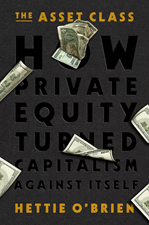
 ● The Asset Class: How Private Equity Turned Capitalism Against Itself
Hettie O’Brien
Review via The Guardian
Private equity partnerships are groups of individual and institutional investors with deep pockets. O’Brien traces their rise following the era of deregulation inaugurated by Reagan and Thatcher, and details how Blackstone, the Qatar Investment Authority, Macquarie, KKR and others have bought undervalued assets using borrowed money to minimise their exposure to risk. What happens next is that costs, wages and investment in the future are frequently cut to the bone in the cause of exceptionally high returns.
 ● Investing in America: The Rise Of A 250-Year Bull Market
Meb Faber
Review & interview with author via ETF Trends
The book was born out of frustration with a generation that learned investing through meme stocks and zero-day options rather than structural ownership. Faber’s remedy is long-term compounding, illustrated by the idea that $1 invested in 1800 would be worth $200 million today. He cited Charlie Munger’s principle: “The first rule of compounding is don’t interrupt it unnecessarily.”
Faber also frames America’s origins as a venture capital story, noting that the Virginia Company and the Plymouth Colony’s Mayflower voyage were financed as joint-stock ventures by profit-seeking investors. Today, roughly 55% of American households own stock, and despite representing only 5% of the world’s population, the U.S. commands two-thirds of global stock market capitalization.
 ● The Next China Is Still China: An Insider’s Playbook for Winning in the New Era
Joe Ngai and Nick Leung
Review via Fortune
When Joe Ngai, McKinsey’s Greater China chair, first began to test-drive his point that “the next China is still China” on social media, the world’s second-largest economy was in a post-COVID slump. Sluggish consumption and a property market crash were still dragging down the country’s economy, while foreign companies were rethinking their investment in China as both a consumer market and a manufacturing hub—and asking where the “next China” might be.
“You heard all these things. We’re trying to diversify away from China. We’re trying to de-risk from China,” Ngai tells Fortune in McKinsey’s Hong Kong office. “You can’t find another China. There’s no other China out there now.”
Ngai’s observation is now a book, The Next China is Still China: An Insider’s Playbook for Winning in the New Era, coauthored with Nick Leung, director of the McKinsey Global Institute and Ngai’s predecessor as Greater China chair.
Please note that the links to books above are affiliate links with Amazon.com and James Picerno (a.k.a. The Capital Spectator) earns money if you buy one of the titles listed. Also note that you will not pay extra for a book even though it generates revenue for The Capital Spectator. By purchasing books through this site, you provide support for The Capital Spectator’s free content. Thank you!
Author: James Picerno