

Iran Tensions Ease, But Markets Still Looking For Fed Rate Hikes
But concerns are simmering that the recent surge in headline inflation, which started easing in June, may be spilling over into core measures of prices… In that case, inflation risk is becoming delinked from the Iran conflict and driven by underlying economic factors – a scenario that raises pr…
The US–Iran conflict has entered a new lull again, animating fresh hopes that the Middle East crisis will go into remission and allow “normal” business‑cycle factors to dominate the outlook for the economy and monetary policy decisions at the Federal Reserve. But as the world has learned since the war started on Feb. 28, looking more than a few days (if not hours) ahead on this topic tends to resemble a coin flip for estimating probabilities.
The challenge for the Fed is that if the fighting is truly over and a measure of normality returns to energy exports from the Gulf, the preference to maintain a wait‑and‑see approach to policy is still reasonable. But concerns are simmering that the recent surge in headline inflation, which started easing in June, may be spilling over into core measures of prices. In that case, inflation risk is becoming delinked from the Iran conflict and driven by underlying economic factors – a scenario that raises pressure on the Fed to raise interest rates.
Deciding which path is more likely is still open for debate, largely because the war and its macro effects continue to evolve and surprise. The effects of this uncertainty are gradually shifting expectations, and the cumulative effect is becoming increasingly clear.
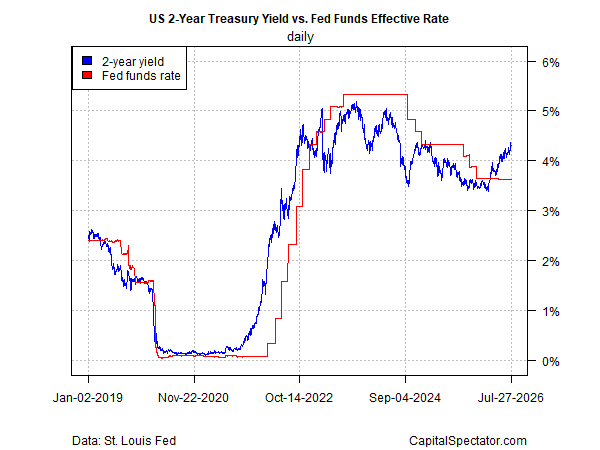
The change in sentiment is clearest in the policy‑sensitive US 2‑year Treasury yield, which is closely watched on Wall Street as a proxy for rate expectations. Although the rate has edged lower in the last two trading sessions, ticking down to 4.33% on Monday (July 27), the rising trend since the bombs started dropping on Iran five months ago is clear. The gap that’s opened up between the 2‑year yield and the 3.63% Effective Fed Funds rate is a stark and unambiguous sign that market sentiment is pricing in high odds for a rate hike in the near term.
Fed funds futures are still leaning into no change for tomorrow’s Fed meeting, estimating a roughly 66% probability that the central bank will leave its current 3.50%–3.75% target interest‑rate range steady in Wednesday’s announcement. But this estimated probability has declined recently while estimates for rate hikes in future meetings have increased. A rate hike at the September FOMC meeting is currently priced at an 80%-plus probability.
The complication for the Fed is that absent the war, monetary policy is arguably at or close to a neutral stance that’s appropriate for current conditions, based on a simple model that uses the unemployment rate and the annual pace of consumer inflation.
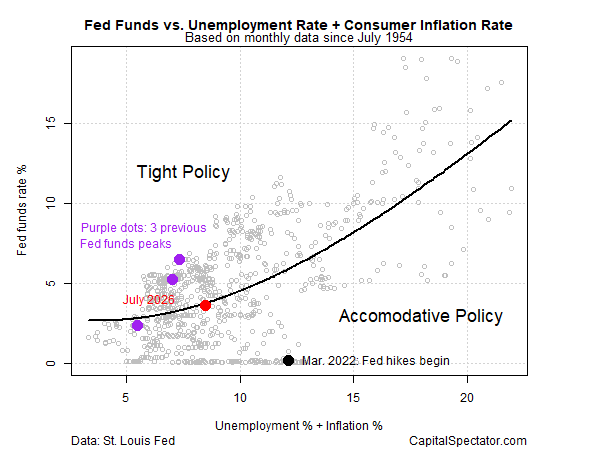
But we live in a world that can’t ignore the Middle East conflict, even though how the Fed should deal with it is unsettled at this stage. As a result, there’s a non-trivial chance for a policy error. If the war continues, even in fits and starts, inflation risk will continue to rise, which raises the odds that the Fed will lose the ability to keep a lid on price pressure without pre-emptive action.
Alternatively, if the conflict winds down and energy exports ramp up, headline inflation will continue to cool, reducing the pressure to raise rates. On that basis, hiking could uncecessarily slow the moderate economic expansion.
The main challenge is that both scenarios are plausible, which implies that standing pat is still reasonable. But the Treasury market is losing patience with this view, which may force the Fed’s hand if yields continue to trend higher.
That puts Fed Chairman Kevin Warsh in the position of having to rationalize tomorrow’s policy decision and manage expectations for the months ahead. The biggest risk is the central bank’s credibility, which could take a hefty blow if it mismanages policy at this juncture.
One facet of this puzzle, at least, is clear: Inflation continues to run well above the Fed’s 2% inflation target, based on headline and core measures of the Personal Consumption Expenditures (PCE) price index, which has long been cited as the central bank’s preferred measure. Warsh has been pushing to refocus on other inflation metrics, which reflect a softer pricing trend.
Perhaps at tomorrow’s press conference the Fed chief will point to alternative indicators to argue that inflation is lower than it appears based on the standard metrics. Depending on your perspective, such a redirection will signal a healthy shift toward focusing on more reliable inflation measures, or an act of desperation.

Author: James Picerno