

The Fed’s Patience Strategy Faces Its First Real Test
Explaining the central bank’s decision to leave its target interest rate unchanged yesterday amid mounting inflation concerns, he tried to walk a fine line, saying that price stability remained the goal…Incoming inflation data could yet validate the Fed’s cautious approach to rate hikes… …
Federal Reserve Chairman Kevin Warsh is playing a dangerous game. Explaining the central bank’s decision to leave its target interest rate unchanged yesterday amid mounting inflation concerns, he tried to walk a fine line, saying that price stability remained the goal. But the bond market is skeptical and Treasury yields rose yesterday.
Incoming inflation data could yet validate the Fed’s cautious approach to rate hikes. But there’s also the crucial aspect of credibility, which was dented, if only slightly, by Warsh’s comments in yesterday’s press conference.
“We will deliver the 2% inflation target,” he said. “That is the definition of price stability.” That was an unfortunate formulation with inflation still running well above that mark. His lack of clarity on explaining and framing the gap suggests his communciation strategy needs revising.
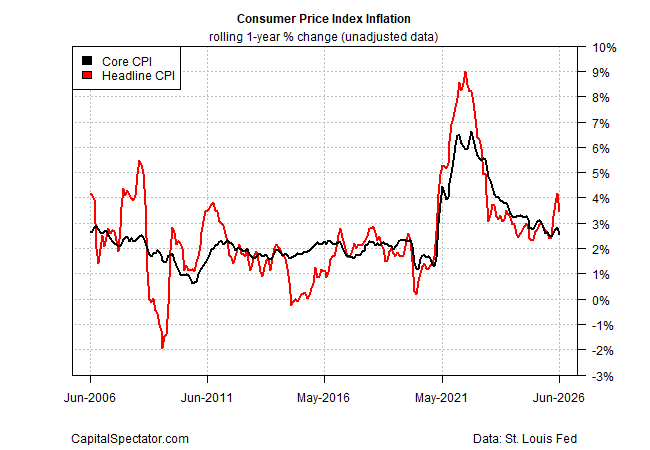
Today’s June update on personal consumption expenditure prices (PCE inflation) is expected to cool, provide a bit of respite on the data front, but the expected report will still leave a yawning gap between the Fed’s target and the actual year-over-year trend, as the previously published numbers for consumer prices in June imply.
When asked why the Fed was waiting to raise rates, he was evasive and failed to persuasively outline the rationale. The bond market wasn’t impressed. Treasury yields rose, including the 30-year yield, the most inflation-sensitive maturity, which spiked to 5.20% — the highest close since 2007.
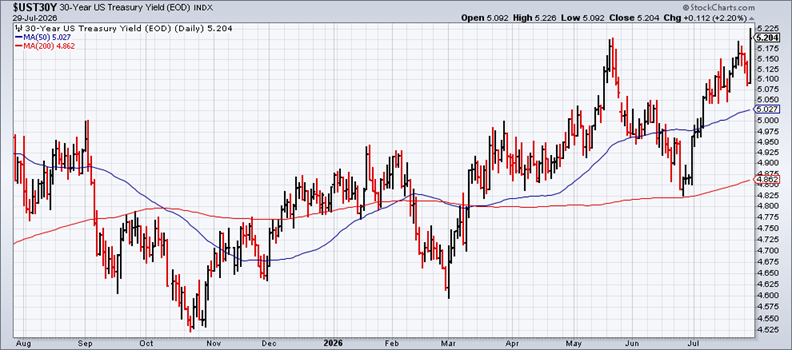
The Fed chairman asked for patience in judging the central bank’s record on managing inflation, reasoning that his short tenure since taking the helm in May is too soon to judge. Fair point, but the bond market won’t distinguish inflation risk between his predecessor’s challenge and current conditions. It’s all one continuous stream, a non-trivial point with inflation running meaningfully above the 2% target for more than a year, accelerating in recent months.
The current moment is especially fraught as a new escalation in the Iran war unfolds, which threatens to keep energy prices elevated. It’s understood that the Fed focuses on core inflation indicators, which strip out food and energy, which provides a cleaner, more reliable measure of the trend. But core inflation has been rising too.
The softer data in June via the Consumer Price Index (CPI), which will presumably be confirmed in today’s PCE price report, is encouraging. Per his previous comments, Warsh may also be relying on alternative inflation indicators to support a wait‑and‑see approach to a policy pivot. The Dallas Fed’s Trimmed Mean PCE inflation rate, for example, is running in the low‑2% range through May.
Yet the resumption of hostilities in the Middle East, and the ongoing near‑complete blockage of exports through the Strait of Hormuz, suggests that inflationary pressure will remain a threat for the foreseeable future. Pointing to alternative inflation metrics to argue that the Fed’s job is more or less complete won’t fly with the bond market.
The key risk is that headline inflation starts spilling over into mainstream core measures. There are hints that this transmission is developing. Even if the Fed’s decision to stand pat is justified — a reasonable view, according to some economists — Warsh’s suggestion that the bond market would do the Fed’s job for now in reacting to inflation pressures is not a good look for a central bank trying to establish its monetary bona fides this early in his tenure.
He insisted that “this Fed will not waver” in its obligation to lower inflation to the target. “Our credibility rests on performing our duties and delivering on our responsibilities.”
Those words will ring hollow if the Fed doesn’t persuade the bond market. The central bank lost some of its influence capital yesterday. Softer‑than‑expected inflation reports could come to the rescue, of course. But the opposite scenario is plausible too.
Make no mistake: the bond market is testing the Fed chairman. The good news is that he still has time to make a course correction. But if yesterday’s discussion is a guide for his guidance strategy, the months ahead could be a rocky road for the Fed’s influence and the bond market.
Is Recession Risk Rising? Monitor the outlook with a subscription to:
The US Business Cycle Risk Report
Author: James Picerno