

Disinflation Stalls and the Fed’s Margin for Error Just Got Thinner
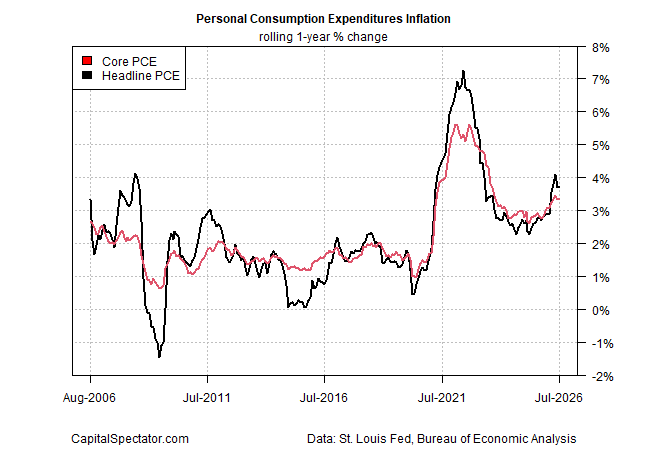
The July inflation report wasn’t surprising, but it was revealing…The Personal Consumption Expenditures Price Index (PCE), reportedly the Federal Reserve’s preferred inflation yardstick, was steady last month, rising at a 3… PCE inflation continues to print at the pace that has prevail…
The July inflation report wasn’t surprising, but it was revealing.
The Personal Consumption Expenditures Price Index (PCE), reportedly the Federal Reserve’s preferred inflation yardstick, was steady last month, rising at a 3.7% year‑over‑year rate. Core PCE, which strips out food and energy for a cleaner read on the trend, held at a slightly softer 3.3%.
Overall, no surprises. PCE inflation continues to print at the pace that has prevailed recently. Economists expected as much, and on that basis one is tempted to conclude: nothing to see here — move on.
Yet that view is too glib. The PCE results may be calm relative to recent months, but the report suggests that counting on disinflation to prevail in the near term — and do some, if not most, of the Federal Reserve’s work — looks a bit more remote.
In short, inflation isn’t accelerating, but neither is it cooling. That could change, of course, and there are several reasons to make that case. One is the possibility that economic activity is slowing. But the data is mixed at the moment, and it may take several months to develop a cleaner reading on the macro trend.
What is clear is that recession risk remains low, and so expecting a substantial downshift in the economy to materially soften inflation is, for now, a bridge too far.
My analytics suggest that while there is reason to expect inflation could downshift in the near term based on economic conditions and trend, several offsetting factors may slow or even reverse a disinflationary impulse.
One of those offsetting factors is the Iran conflict. With no end in sight, this gray‑zone risk looks set to continue well into the future, keeping energy prices elevated and delaying meaningful disinflationary relief that would likely arrive once the Middle East crisis is genuinely resolved.
The latest sign that a U.S.–Iran stalemate remains the path of least resistance: Iran and Oman on Wednesday announced an agreement to temporarily reopen the Strait of Hormuz, according to an Iranian official. Such a deal won’t fly at the White House — President Trump has warned against this type of arrangement and has threatened to bomb Oman, a U.S. ally, if it “gets in the way.”
A potentially bigger problem for inflation is the bond market’s growing concern over U.S. government debt and the lack of political efforts in Congress to tackle the mounting red ink.
The Treasury Department’s recent plans to increase buybacks of government securities in an effort to lower yields have had some effect. The 30‑year Treasury yield has pulled back from its recent peak, but only modestly, and it’s unclear whether further declines are likely.
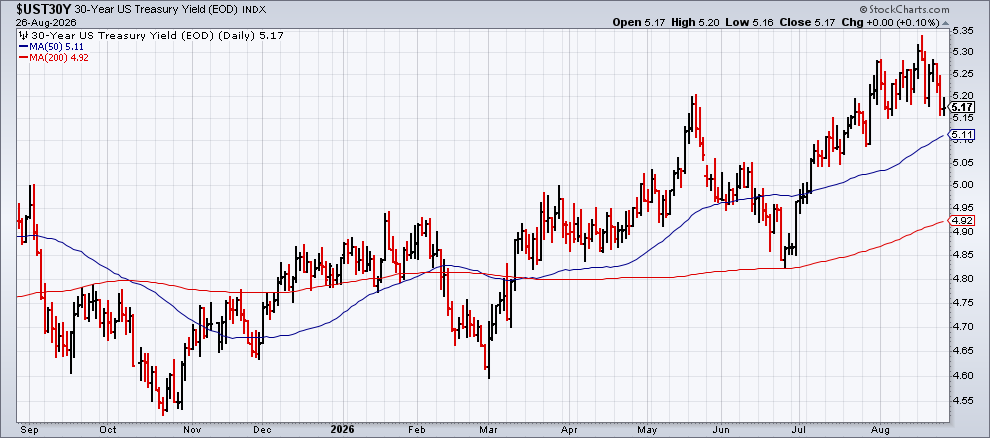
Another issue that could keep Treasury yields higher, or rising, for longer: uncertainty about how, when, or if the Federal Reserve will tame inflation, which has been running above the Fed’s 2% target for more than five years.
Tomorrow’s speech by Fed Chairman Kevin Warsh at the Jackson Hole meeting is an opportunity to clarify how the central bank will operate with regard to its mandate to keep inflation near 2% over the long run. But given his recent comments downplaying the case for forward guidance, it’s possible — if not likely — that Warsh won’t offer any new details on Friday.
In that case, the bond market’s reaction (or non‑reaction) next week could be pivotal for setting the tone in markets for the fall.
Is Recession Risk Rising? Monitor the outlook with a subscription to:
The US Business Cycle Risk Report
Author: James Picerno