

US Economy Picks Up in Q3 as Rising Rates Threaten Momentum
If correct, the rise will be the strongest quarter in a year… A strong rebound in retail sales in August is another sign of economic resilience…2% last month versus July, nearly twice what economists were expecting and the strongest increase since March… One concern is that geopolitical tensi…
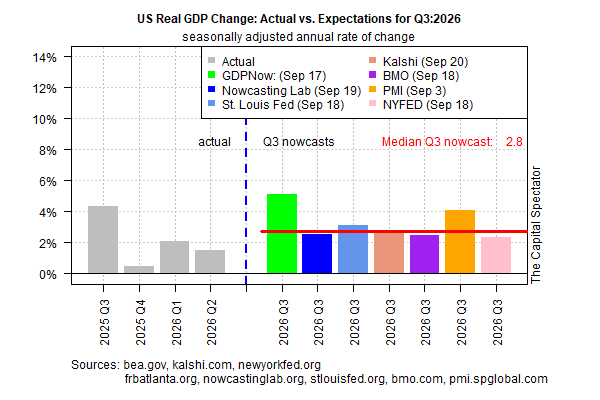
The US economy continues to show signs of rebounding in the third quarter after downshifting in Q2, according to several GDP nowcasts. Rising interest rates cloud the outlook for the year’s final quarter and beyond, but next month’s release of the Q3 GDP report is expected to show a solid pickup in output.
Economic growth is on track to rise 2.8% at an annualized rate, based on the median nowcast for a set of estimates compiled by The Capital Spectator. The projected gain marks a near doubling vs. Q2’s 1.5% increase. If correct, the rise will be the strongest quarter in a year. The government’s official data for the current quarter is scheduled for release on Oct. 29.
Recent data has highlighted a pickup in activity, which is captured in today’s 2.8% median nowcast, which has been revised up from the 2.4% estimate published earlier this month.
Several alternative measures of the US economy also reflect a pickup in growth recently. The Dallas Fed’s Weekly Economic Index (WEI) indicates year-over-year GDP growth at 3.1% through Sep. 12, marking a solid strengthening versus the 2.1% increase reported in the official GDP numbers through Q2.
A strong rebound in retail sales in August is another sign of economic resilience. Spending rose 1.2% last month versus July, nearly twice what economists were expecting and the strongest increase since March. The control group, which excludes certain categories and serves as a proxy for calculating goods spending in GDP, also rebounded sharply, jumping 1.4%.
Inflation concerns and rising Treasury yields cloud the outlook beyond Q3, factors that contributed to the Federal Reserve’s decision to raise its target rate last week for the first time in three years.
One concern is that geopolitical tensions and supply disruptions in global energy markets could tighten diesel supplies and keep inflation elevated. Because diesel powers the commercial transportation and heavy machinery behind critical supply chains, higher diesel prices can drive broader consumer inflation than gasoline by raising production and delivery costs across nearly all goods.
The potential for inflation effects is clear, with diesel prices surging to record highs lately. As diesel costs rise, businesses face higher expenses for moving raw materials and finished goods through the supply chain. If those higher costs begin feeding into consumer prices, inflation could remain elevated or decline more slowly than expected. In that scenario, the Fed may be inclined to raise rates further, which could reduce consumer spending and economic growth.
Fed funds futures are pricing in one to two more rate hikes by year-end. Next week’s release of PCE inflation data, the Fed’s preferred measure for tracking price trends, for August could play a role in reshuffling expectations. In July, core PCE rose 3.3% versus the year-ago level, unchanged from the previous month and highlighting inflation running well above the Fed’s 2% target. A repeat performance for August would likely lift confidence that another Fed rate hike is near.
Is Recession Risk Rising? Monitor the outlook with a subscription to:
The US Business Cycle Risk Report
Author: James Picerno