

Aderant builds intelligent ticket triage with Amazon Nova
In this post, we share how Aderant, a global provider of business management software for the legal industry, built an intelligent ticket triage system using Amazon Nova Lite through Amazon Bedrock… Aderant’s solution automates much of the context gathering, classification, routing, and knowled…
This guest post is co-written by Angela Mapes and Adam Walker of Aderant.
In this post, we share how Aderant, a global provider of business management software for the legal industry, built an intelligent ticket triage system using Amazon Nova Lite through Amazon Bedrock. Aderant’s solution automates much of the context gathering, classification, routing, and knowledge enrichment required for support-ticket triage.
The Intelligent Ticket Analyzer supports Aderant’s 38-person SierraOps team, which operates Expert Sierra across 268 client environments globally. It reviews newly submitted, unassigned tickets during scheduled hourly processing cycles on business days. It gathers operational context from Jira, Confluence, Amazon Athena, and Microsoft SharePoint to recommend a team assignment and resolution starting point, and it automates approved routing and communication actions.
During the first 2.5 weeks of production, from June 30 through July 17, 2026, the analyzer reviewed 109 tickets and achieved approximately 96% routing accuracy. Based on the team’s measured pre-automation triage baseline, Aderant estimates that the system recovers 8–14 engineering hours per week at a total operating cost of less than $30 per month.
The deployment extends Aderant’s earlier AI journey from unified search and on-demand investigation with Amazon Quick to scheduled, autonomous operational workflows powered by Amazon Nova.
The challenge: Reduce operational toil without losing control
Aderant’s SierraOps team processes an average of 34–40 support tickets per week. Before automation, each ticket required 15–25 minutes of manual investigation before resolution work could begin. Engineers had to interpret the request, locate client-environment details, determine ownership, search documentation and ticket history, and then assign or redirect the work.
The cost was broader than triage time alone. Misrouted tickets could remain in the wrong queue until an engineer identified them, while less-experienced team members needed more time or senior-engineer guidance to find the right context and make routing decisions.
Aderant needed automated, repeatable investigative workflows so engineers could focus on complex troubleshooting, platform improvement, and proactive operations while preserving human review for lower-confidence decisions.
The solution: Autonomous ticket analysis with human safeguards using Amazon Nova
Aderant built the Intelligent Ticket Analyzer as a serverless workflow orchestrated by a single AWS Lambda function and triggered hourly on weekdays by Amazon EventBridge. For each unassigned ticket in the CloudOps queue, the solution follows five stages:
- Identify: Retrieve unassigned tickets from Jira.
- Enrich: Gather client metadata from Amazon Athena, relevant knowledge from Confluence and SharePoint, and comparable resolved tickets from Jira.
- Classify: Send the ticket and assembled context to Amazon Nova Lite through the Amazon Bedrock Converse API for structured classification and recommended next steps.
- Act: Post analysis and acknowledgments, reassign misrouted tickets, notify the appropriate Microsoft Teams channel, and apply predefined actions for support-resolvable scenarios.
- Observe and improve: Publish operational metrics to Amazon CloudWatch and route lower-confidence classifications to human review.
Routing and reassignment decisions can operate autonomously when confidence meets the configured threshold. Lower-confidence tickets are flagged for human review. The team monitors confidence, misroutes, and processing latency, reviews routing corrections weekly, and uses the findings to refine prompts and routing logic.
Why Amazon Nova
Aderant chose Amazon Nova Lite after evaluating multiple foundation models through Amazon Bedrock using real ticket data. Three factors drove the decision.
Operational specificity: In comparisons using the same ticket content, environment data, runbooks, and resolution history, the team found that Amazon Nova Lite extracted more specific resolution steps and correlated past issues more effectively than the other evaluated models.
Native AWS integration: Amazon Nova Lite integrates with the Amazon Bedrock Converse API, AWS Identity and Access Management (IAM) permissions, the AWS SDK, and the existing AWS environment, reducing the need for an additional external model provider or vendor contract.
Economics at ticket scale: The model’s cost profile made it practical to analyze routine tickets, not only high-priority cases. In the initial production period, total system cost remained under $30 per month and Bedrock inference cost remained under $1 per month.
Architecture
The following diagram shows the architecture of the Intelligent Ticket Analyzer. The data flow moves sequentially from left to right through seven stages, all deployed through a single AWS Serverless Application Model (AWS SAM) and AWS CloudFormation template.
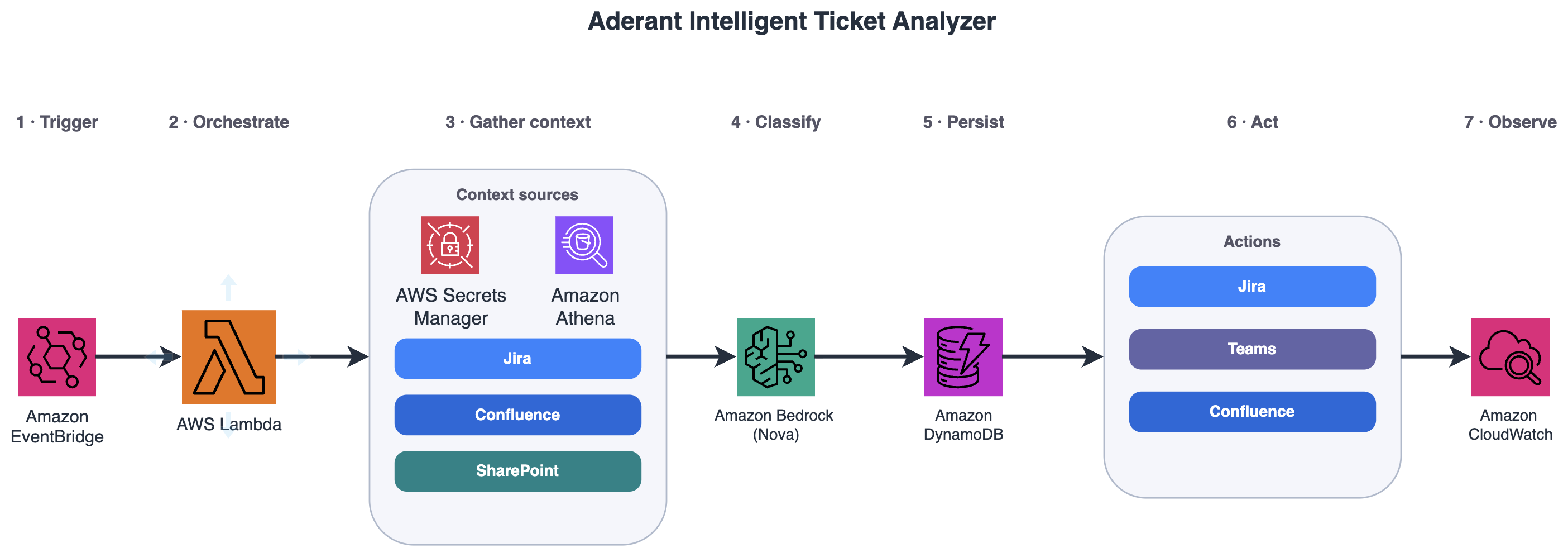
Figure 1: Architecture of the Intelligent Ticket Analyzer
Amazon EventBridge triggers AWS Lambda. The function retrieves credentials from AWS Secrets Manager, queries environment metadata through Amazon Athena, and calls Jira, Confluence, and Microsoft Graph APIs for ticket and knowledge context. Amazon Bedrock returns structured classification output from Amazon Nova Lite. Amazon DynamoDB supports cross-ticket pattern tracking, while Jira, Microsoft Teams, and Confluence receive the resulting actions and updates. Amazon CloudWatch provides operational monitoring.
Data boundary: The analyzer uses internal operational ticket data, operational metadata, and internal knowledge sources. It does not access, process, or store client matter data or client application business data.
Early operational impact
The first 2.5 weeks of production provided an early view of both accuracy and efficiency. Routing accuracy was measured by comparing the analyzer’s assignment with the team that ultimately resolved each ticket. Time savings were based on a four-week pre-deployment baseline of 15–25 minutes of manual triage per ticket.
| Metric | Early production result |
| Production measurement period | June 30–July 17, 2026 |
| Tickets analyzed | 109 |
| Routing accuracy | Approximately 96% (4 misroutes) |
| Average ticket volume | 34–40 per week |
| Measured manual triage baseline | 15–25 minutes per ticket |
| Estimated engineering time recovered | 8–14 hours per week |
| Estimated monthly time recovered | 32–56 hours |
| Total system cost | Under $30 per month |
| Amazon Bedrock inference cost | Under $1 per month |
The recovered capacity is redirected toward complex troubleshooting, infrastructure improvements, and proactive work requiring human judgment. These findings represent an early production period and should be read as initial operational results rather than a long-term performance benchmark.
Three production examples
Correcting a misrouted request
A ticket describing a 404 error on an Azure DevOps site arrived in the CloudOps AWS queue. The analyzer classified it as a CloudOps Azure issue, updated the team field, and notified the requester of the reroute.
Accelerating resolution readiness
For an after-hours remote-access configuration request, the analyzer combined client-environment data with a relevant Confluence article and posted the procedure as an internal comment. The engineer completed the task in under 30 minutes the next morning without additional research.
Extending expertise to newer engineers
For a deployment request requiring PowerShell scripts and service verification, the analyzer provided commands, expected outputs, troubleshooting guidance, and related references. The engineer resolved the request the same day without escalating to a senior engineer.
Turning recurring issues into reusable knowledge
The analyzer also detects recurring issue patterns across clients running the same software version. When the configured threshold is reached, the workflow records the pattern, updates a dedicated Confluence tracking page, monitors resolved tickets for confirmed fixes, and links future matching tickets to the documented resolution.
This creates a continuous knowledge loop: identify a recurring pattern, document it, capture the confirmed resolution, and make that resolution available to future tickets. The capability reduces repeated discovery work and helps operational knowledge become reusable across the team.
Accelerating onboarding and knowledge access
Before the analyzer, unfamiliar ticket types often required manual Confluence searches or guidance from senior engineers. The automated workflow now places client-environment context, matched knowledge articles, and recommended steps directly in the ticket before an engineer begins work.
This does not replace engineering judgment. It gives newer engineers a stronger starting point, helps them handle unfamiliar scenarios earlier in onboarding, and allows experienced engineers to spend more time on complex work.
Five weeks from concept to production
Aderant used progressive validation rather than moving directly to autonomous actions:
- Rules-based start: A Jira automation rule established the initial routing concept but could not incorporate AWS context, ticket history, or model reasoning.
- AI-assisted validation: The existing Amazon Quick CloudOps Helper agent demonstrated that operational data could support useful routing and resolution recommendations.
- Production build: The team implemented the workflow with AWS Lambda and Amazon Nova Lite. Kiro supported integration scaffolding, architecture validation, and test generation.
- Monitoring-only testing: The analyzer ran against live tickets for approximately two weeks while its classifications were compared with manual decisions and the prompts and routing logic were refined.
- Production launch: The solution went live June 30, 2026, five weeks after the initial concept.
Looking ahead
Deeper client-history analysis: Connect related tickets over time to provide a broader view of ongoing client work.
Improved knowledge matching: Evaluate Amazon Bedrock Knowledge Bases for semantic matching when ticket and documentation terminology differ.
Layered AI support: Continue using the analyzer for scheduled triage while retaining the CloudOps Helper bot for deeper, on-demand investigation and follow-up questions.
Conclusion
Aderant’s Intelligent Ticket Analyzer shows how operations teams can move from AI-assisted search to governed automation. In its first 2.5 weeks of production, the system reviewed 109 tickets, achieved approximately 96% routing accuracy, and was estimated to recover 8–14 engineering hours each week while operating for less than $30 per month.
The central design choice was not to ask AI to replace engineers or independently solve every issue. Instead, Aderant applied Amazon Nova Lite to the repeatable investigative work that delayed resolution: assembling context, identifying relevant knowledge, detecting patterns, and routing work with a useful starting point. Human review remains part of the control model for lower-confidence decisions.
By combining autonomous triage, operational safeguards, and a reusable knowledge loop, Aderant created a scalable foundation for reducing operational toil and directing engineering capacity toward higher-value work.
Learn more about Amazon Bedrock and Amazon Nova.
About the authors
Author: Angela Mapes