

Accelerating airline retailing innovation: how Datalex modernized with AWS Experience-Based Acceleration and agentic AI
Stream 1: Microservice prototyping extracted a slice of the Reservation component from the existing n-tier architecture and refactored it into a modern Spring Boot microservice running on Java 21… Stream 2: DevSecOps pipeline built an end-to-end continuous integration and continuous delivery (…
Datalex, a leader in airline ecommerce solutions, set out to answer a question facing every established product-based business: how do you build for where your industry is going, not only where it is today? For more than two decades, Datalex has powered digital retailing for many of the world’s leading airlines, capability built up over years and encoded in a substantial, mission-critical system that runs shopping, pricing, and booking at scale. That depth is a considerable asset, and it is also what makes evolution demanding. The airline industry is moving decisively toward Modern Airline Retailing, an offers-and-orders model with richer integrations and AI-native experiences, and Datalex set out to build the system for that future while carrying forward the proven retail logic its customers rely on every day. The system’s foundations had served that mission reliably for years. The goal now was to modernize the runtime and delivery model so the team could ship the next generation of retailing capability faster, without disrupting the airline operations running on it today. Datalex framed a considered roadmap, Project Phoenix, to get there, and the open question was how much of that journey could be accelerated.
The company’s CTO, Brian Lewis, sponsored the modernization effort and brought together teams across engineering, product, and operations. As Brian Lewis put it, “This is Datalex’s most important project.” The system’s richness was precisely what made the task substantial: years of sophisticated, tightly integrated retail logic that airlines depend on around the clock, built on a mature Java and EJB2 architecture. The team’s central question was never whether the system had value to carry forward, it clearly did, but how to evolve a system of this depth incrementally, at speed and without disruption to airline customers’ operations.
In December 2025, Datalex partnered with AWS for a three-day Experience-Based Acceleration (EBA) workshop. The pace surprised even the system’s own engineers, a measure of how much sophisticated logic they knew sat beneath the surface. As Eric Pitkeathly, Tech Lead, put it: “I did not believe going into the EBA that a migration from EJB/Java 8 to Spring/Java 21 was possible in 3 days! But it was.” This breakthrough did not happen by chance. Following a Modernization Assessment (MODA), the AWS team identified that most of the technological challenges could be accelerated through comprehensive support and the strategic use of agentic AI tools like Kiro and AWS Transform Custom.
This post shares how Datalex used the AWS Experience-Based Acceleration (EBA) methodology to prove modernization feasibility, establish repeatable migration patterns, and integrate generative AI capabilities, all while maintaining their commitment to serving airline customers without disruption.
Solution overview
The AWS Experience-Based Acceleration workshop brought together 16 Datalex engineers with 6 AWS specialists for an intensive three-day engagement at the AWS Dublin offices. Rather than attempting to modernize the entire system at once, the teams focused on proving feasibility through four parallel workstreams, each tackling an important aspect of the modernization journey.
- Stream 1: Microservice prototyping extracted a slice of the Reservation component from the existing n-tier architecture and refactored it into a modern Spring Boot microservice running on Java 21. This workstream proved that migration was technically feasible and established reusable patterns for the remaining code base. The Modernization Assessment revealed a decisive insight: by building a compatible runtime environment, the team could run the system’s existing code on modern technologies with minimal modifications. This was clear evidence that Datalex’s foundations were fundamentally sound and could serve as the stepping stone to the modern system rather than something to be rebuilt from scratch. The remaining code changes were then automated through AI-powered coding assistants like Amazon Q Developer and Kiro, accelerating the transformation.
- Stream 2: DevSecOps pipeline built an end-to-end continuous integration and continuous delivery (CI/CD) pipeline using AWS services including Amazon Elastic Container Service (Amazon ECS), Amazon Elastic Container Registry (Amazon ECR), and AWS Security Hub. The pipeline embedded security scanning at every stage, from code commit through container deployment. This implemented a shift-left security approach that validates infrastructure as code before deployment.
- Stream 3: QA and observability added proactive, real-time monitoring across the system. The team implemented comprehensive observability using Amazon CloudWatch Container Insights, CloudWatch Logs, and Datadog for application performance monitoring. Using the Strangler Fig pattern, the AWS team advised implementing a gateway that could route requests to either the existing REST API or the modernized API through a simple parameter change. This architectural approach supported rapid non-regression testing and real-time validation of the modernization strategy, all within the three-day timeframe. The QA team also created custom dashboards that provide real-time visibility into system health and performance metrics.
- Stream 4: Agentic AI proof of concept demonstrated how generative AI could enhance the system. Using Amazon Bedrock AgentCore, the team built an AI-powered natural language interface for booking retrieval integrated with the existing REST API. The multi-agent orchestration system included specialized agents for authentication, data retrieval, and reporting, all secured through Amazon Cognito and integrated with Kong API Gateway.
The target architecture uses Amazon ECS for container orchestration, with Kong API Gateway providing protocol translation between REST and SOAP while supporting dynamic routing between existing and modernized services. With this approach, Datalex can modernize incrementally without disrupting existing airline operations.
Architecture overview
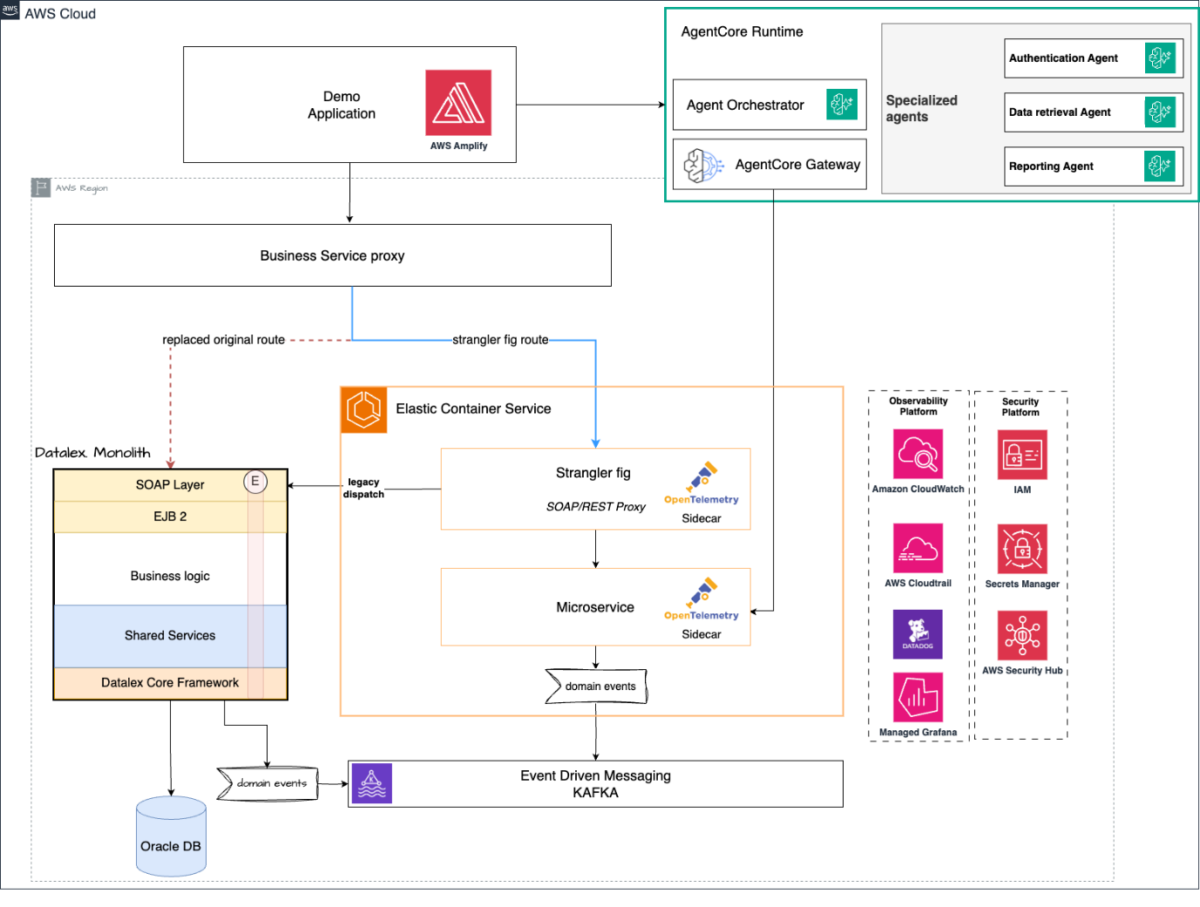
Modernizing an airline retail system requires integrating new capabilities while maintaining existing operations. Datalex’s architecture shows how to layer generative AI agents, modern microservices, and enhanced observability onto an established, proven system without disrupting customer-facing services. The architecture uses a business service proxy to route traffic between existing and modernized components while maintaining backward compatibility.
Datalex structured their modernization around the following components:
- Demo application: Angular-based frontend demonstrating the modernized user experience.
- Agent orchestrator: Amazon Bedrock coordinates multiple specialized agents for different workflows.
- Business service proxy: Routes requests between existing n-tier architecture and new microservices.
- Modernized services: Spring Boot microservices (SOAP connector and core services) replacing EJB components.
- Current n-tier architecture: Existing services continue operating while being incrementally replaced.
- Event-driven messaging: Apache Kafka enables asynchronous communication between components.
- Observability stack: Amazon CloudWatch, Amazon Managed Grafana, and AWS X-Ray provide monitoring across the layers.
- Security infrastructure: AWS Secrets Manager and AWS Identity and Access Management (IAM) handle authentication and authorization.
Datalex’s AWS cloud environment serves as the foundation, with the business service proxy acting as the request traffic controller. The proxy routes incoming requests to either the existing n-tier system or the new Spring Boot microservices based on migration status. This approach lets Datalex move services incrementally without requiring a big-bang cutover.
The agent orchestrator integrates with Amazon Bedrock AgentCore to manage three specialized agents: authentication, data retrieval, and reporting. These agents handle specific workflows, calling into both existing and modernized services through the API Gateway and business service proxy. An event-driven architecture using Kafka decouples components and enables real-time data processing.
The architecture confirms that Datalex can modernize individual services independently while maintaining system stability. Existing components remain fully operational until their replacements are tested and ready for production traffic.
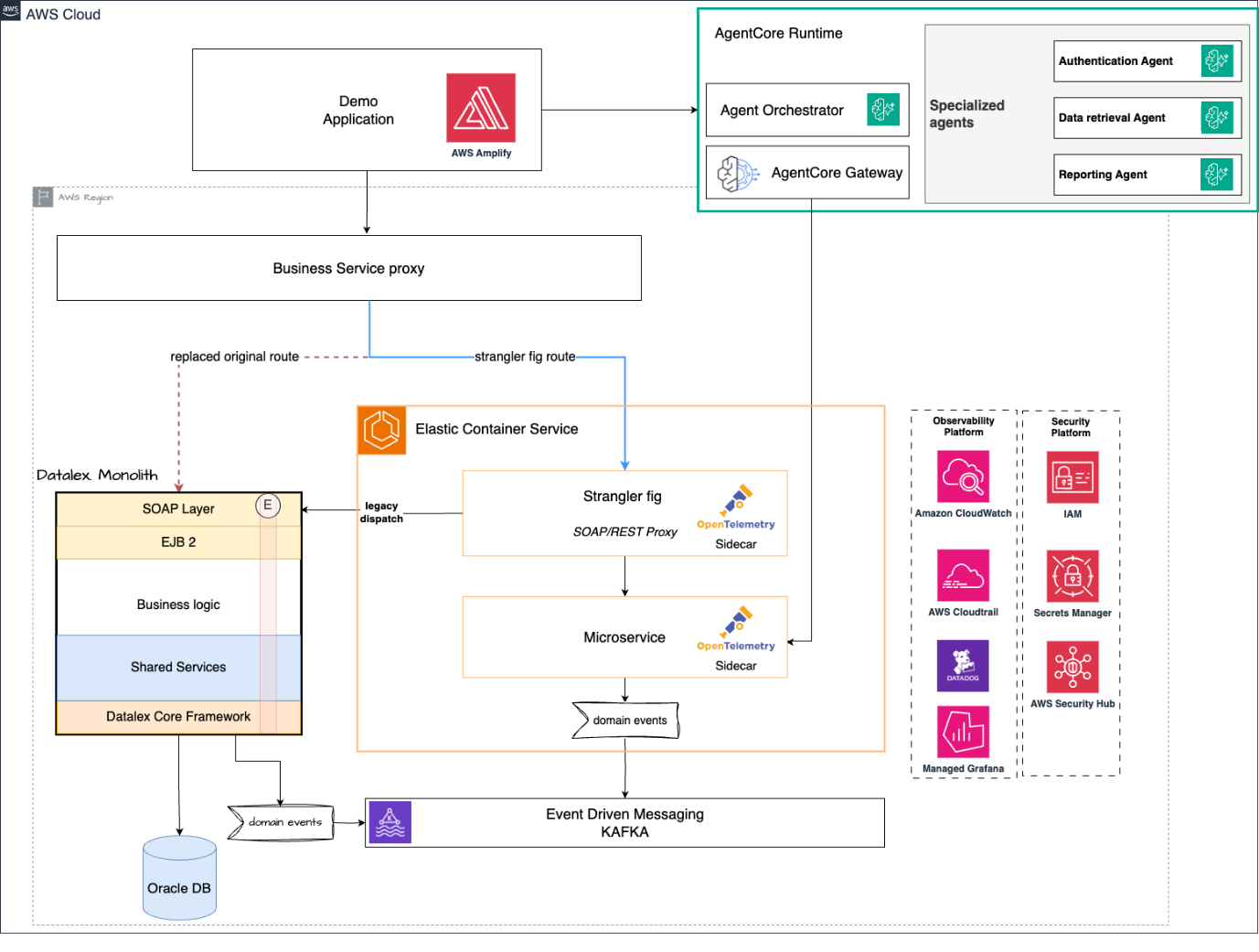
Figure 1: Datalex target architecture with the business service proxy routing between existing and modernized services
The high-level workflow is summarized as follows:
- Route traffic intelligently: Business service proxy directs requests to existing or modernized services based on component status.
- Deploy modernized microservices: Spring Boot services run alongside the existing n-tier architecture in AWS.
- Integrate agent orchestration: Amazon Bedrock manages specialized agents that call both old and new services.
- Enable event-driven patterns: Kafka handles asynchronous messaging between decoupled components.
- Implement comprehensive monitoring: CloudWatch, Grafana, and X-Ray track performance across components.
- Manage secrets centrally: AWS Secrets Manager handles credentials for both existing and modern services.
- Support multiple deployment sources: CI/CD pipelines from GitHub, ECR, and Terraform provision infrastructure.
- Maintain backward compatibility: API Gateway preserves existing interfaces while routing to new implementations.
- Validate incrementally: Each migrated service is tested before the next migration begins.
Technical implementation
Modernizing the system
The prototyping workstream tackled one of the most daunting aspects of the modernization: extracting business logic from a tightly coupled code base. The team selected the Reservation component as their proof of concept because it represented typical complexity found throughout the code base.
The migration involved several technical transformations:
Runtime modernization: Moving from Java 8 to Java 21 brought immediate benefits. Virtual threading capabilities improved concurrent processing, while optimized garbage collection reduced the memory footprint. The team measured a 35% reduction in memory usage compared to the previous JBOSS deployment.
Framework transition: Replacing EJB2 with Spring Boot streamlined the architecture and improved developer productivity. Spring’s extensive testing support improved feature test coverage, while the framework’s modular design allowed for smaller, locally testable service components.
Containerization: Packaging the microservice as a Docker container supported deployment flexibility. The team configured Amazon ECS Fargate to handle container orchestration, avoiding the operational overhead of managing Amazon Elastic Compute Cloud (Amazon EC2) instances running JBOSS.
The migration pattern established during the workshop provides a repeatable approach for the remaining services. Teams can now identify bounded contexts within the system, extract business logic with dependency analysis, refactor to Spring framework patterns, containerize with security hardening, and deploy through an automated pipeline, all while running in parallel with the existing system during transition.
Building production-grade CI/CD
The DevSecOps workstream transformed deployment from a manual, hours-long process into an automated pipeline that completes in under 10 minutes. The pipeline architecture integrates security at every stage:
Build stage: Code commits trigger automated builds using AWS CodeBuild. The build process includes dependency scanning and static code analysis, catching security vulnerabilities before they reach production.
Container security: Images pushed to Amazon ECR undergo automated security scanning. The pipeline validates that the images meet security standards before deployment, with findings aggregated in AWS Security Hub.
Infrastructure validation: Terraform modules defining infrastructure undergo security scanning to verify compliance with organizational policies. This infrastructure-as-code approach provides consistency across environments while maintaining security guardrails.
Deployment automation: The pipeline supports multiple deployment strategies including blue/green deployments for zero-downtime releases, canary deployments for gradual rollout validation, and rolling updates for incremental changes. Native rollback capabilities in Amazon ECS support rapid recovery without operator intervention, improving mean time to recovery.
Implementing comprehensive observability
The observability workstream extended the system with real-time insight into system behavior. The team implemented a multi-layered monitoring approach:
Infrastructure monitoring: Amazon CloudWatch Container Insights provides visibility into container-level metrics including CPU, memory, network, and disk utilization. CloudWatch Logs aggregates logs from the containers for centralized troubleshooting.
Application performance monitoring: Datadog integration provides distributed tracing across microservices, so teams can track requests as they flow through the system. Custom business metrics dashboards surface key performance indicators relevant to airline retail operations.
Proactive monitoring: CloudWatch Synthetics runs automated tests against critical endpoints, alerting teams to issues before customers experience them. This proactive monitoring reduces mean time to detection and resolution.
The observability system also includes an artificial booking generator that streamlines testing for engineering teams, so they can validate performance without requiring production-like data.
Integrating agentic AI
The AI workstream demonstrated how generative AI capabilities could layer onto the modernized architecture without requiring complete system rewrites. The implementation uses Amazon Bedrock AgentCore to orchestrate multiple specialized agents:
Agent architecture: An orchestrator coordinates three specialized agents: an authentication agent for identity verification, a data retrieval agent for accessing business information, and a reporting agent for generating insights. Each agent communicates with backend services through Amazon Bedrock AgentCore Gateway, which translates between the agent’s natural language interface and the system’s REST APIs.
Security implementation: Amazon Cognito provides user authentication and authorization, so airline customers can own agent configuration while maintaining security boundaries. The Model Context Protocol (MCP) Gateway acts as an intermediary between AI agents and REST APIs to support secure communication.
Use case validation: The team built a conversational interface for booking retrieval, so users can query reservation data using natural language. The agent translates conversational queries into API calls, retrieves data from existing Datalex REST APIs, and presents results in a user-friendly format.
This proof of concept validated the technical feasibility of AI integration and established patterns for future AI-enabled features. The architecture provides a foundation for intelligent automation and conversational interfaces that could differentiate Datalex’s product offerings in the airline retail landscape.
Architecture considerations
The target architecture balances modernization goals with operational realities. Amazon Bedrock AgentCore Gateway serves as an important integration layer, supporting gradual migration by routing traffic between existing and modernized services based on configurable rules. With this strangler fig pattern, Datalex can modernize incrementally while maintaining system continuity.
Multi-AZ deployment across Amazon ECS provides high availability, while auto scaling based on CPU and memory metrics makes sure the system can handle traffic variations without manual intervention. The containerized architecture reduces hosting costs through more efficient resource utilization compared to the previous Amazon EC2-based deployment.
Benefits and results
The three-day Experience-Based Acceleration (EBA) delivered outcomes that exceeded expectations. The workshop achieved a 4.9 out of 5.0 customer satisfaction score, with 98% of participants rating their experience as “extremely satisfied.”
Accelerated feasibility proof: What Datalex estimated would take weeks or months to validate independently was accomplished in three days. As the Tech Refresh Dev Manager noted, the AWS team provided a “force multiplier” effect, bringing specialized expertise across modernization, DevOps, and AI/ML domains.
Established migration patterns: The workshop created reusable patterns for migrating the remaining 4 million lines of code. Teams now have documented approaches for extracting services from the n-tier architecture, building secure CI/CD pipelines, implementing observability, and integrating AI capabilities.
Measurable performance improvements: The modernized architecture delivers tangible benefits including a 35% reduction in memory footprint, deployment time reduced from hours to under 10 minutes, 60% faster startup time with Java 21 optimizations, and automated scaling without manual intervention.
Competitive advantage: The modernization positions Datalex to meet growing customer demand for a modern, extensible system. The proven migration path and AI integration capabilities provide competitive differentiation in the airline retail technology landscape.
Cost optimization: Lower hosting costs result from the smaller memory footprint of Spring services compared to existing JBOSS instances. Reduced operational overhead through automation and removal of manual scaling further decreases the total cost of ownership.
Developer productivity: As CTO Brian Lewis observed, “Things that would have taken weeks have been completed in a day.” The modern tooling and frameworks improve the developer experience, while the microservices architecture supports parallel team development and faster iteration cycles.
Looking ahead
Datalex plans to build on the Experience-Based Acceleration (EBA) outcomes through a phased approach. The immediate focus involves maturing the Spring framework to run in parallel with existing JBOSS infrastructure, so teams can gain operational experience before migrating production services.
The company will identify the first production candidate service for migration using the established patterns. The team will implement comprehensive health checks across microservices to support production readiness. They will also quantify cost savings from containerization to provide concrete data for sales teams and executive decision-making.
The AI agent proof of concept opens new product opportunities. Datalex’s product management team will evaluate whether to offer AI-enabled features as product add-ons for airline customers. The conversational interface could improve customer self-service capabilities and reduce operational overhead through intelligent automation.
A follow-up workshop will maintain momentum and address additional modernization challenges. The ongoing partnership with AWS provides access to expertise and best practices as Datalex continues the transformation journey.
Business outcome
The Datalex board approved a significant investment for their technology modernization work, and their prototype tiger team expanded into a fully working Agile team. The Experience-Based Acceleration (EBA) engagement yielded a significant budget for the re-systeming scope of work, with executive-facing KPIs for each quarter mapped against their internal deliverables.
How the Experience-Based Acceleration approach made the difference
The EBA shortened discovery. Datalex estimated 8–12 weeks to validate whether the Reservation component could be extracted without breaking dependencies. With AWS specialists working alongside their engineers, the team had a working response by the end of day one.
It removed cross-cutting blockers. The DevSecOps pipeline required expertise across container scanning, infrastructure validation, and deployment patterns spanning multiple AWS services. The AWS team brought that knowledge into the room, saving weeks of trial and error.
It created evidence for investment decisions. After three days, the team had working code and measurable results they could present to the board. These were proof points that would otherwise have taken three to four months of part-time effort.
Conclusion
Datalex migrated their core services from EJB/Java 8 to Spring Boot/Java 21 in three days during the EBA workshop. The migration established patterns the team now uses across their system, reducing what would have been months of uncertainty into a repeatable process.
The workshop addressed a specific problem: Datalex needed to know if modernization was practical for their code base. By working through one service end-to-end, the team got their response. They also got working code that handles authentication, implements observability, and can run generative AI features, all without rewriting the entire system.
Three lessons from this engagement apply to other modernization projects. First, prove it works on one service before planning the full migration. Second, your team needs to be in the room when the migration happens, because documentation alone will not capture the decisions that matter. Third, add security and monitoring during the migration, not after.
Datalex can now respond to market changes faster and ship features their airline customers are asking for. Their CTO calls this their most important project, and the three-day EBA gave them the technical proof they needed to commit.
If you are planning a similar modernization, AWS Professional Services offers EBA workshops that can help validate your approach. Contact your account team to discuss how this model might work for your system.
Learn more
To learn more about AWS Experience-Based Acceleration programs, visit the AWS Professional Services page. For information about modernizing Java applications, see the AWS Modernization Hub.
About the authors
Author: Kanniah Vagathupatti Jaikumar