
A Triad of Risk Factors Stalks Markets This Week
The resilience of global markets will be tested anew this week as investors grapple with the implications of three risks that could roil sentiment: slower economic growth, the Supreme Court’s ruling that President Trump’s tariffs are illegal, and the threat of a US strike on Iran… “With tari…
The resilience of global markets will be tested anew this week as investors grapple with the implications of three risks that could roil sentiment: slower economic growth, the Supreme Court’s ruling that President Trump’s tariffs are illegal, and the threat of a US strike on Iran.
Let’s start with the US economy, which posted sharply slower growth in Friday’s fourth‑quarter GDP report. Output rose 1.4% — roughly half the pace expected and far behind the much stronger increases of 4.4% and 3.8% in the third and second quarters, respectively. The government shutdown was a key factor that weighed on economic activity and was estimated to have reduced growth by a percentage point.
The economy probably cooled even without the shutdown, but the slowdown was exaggerated in the official Q4 numbers. “The core of the economy is resilient,” said Michael Pearce at Oxford Economics. “With tariff pressures fading and tax cuts beginning to fuel an increase in capital spending, the economy will gather momentum in 2026.”
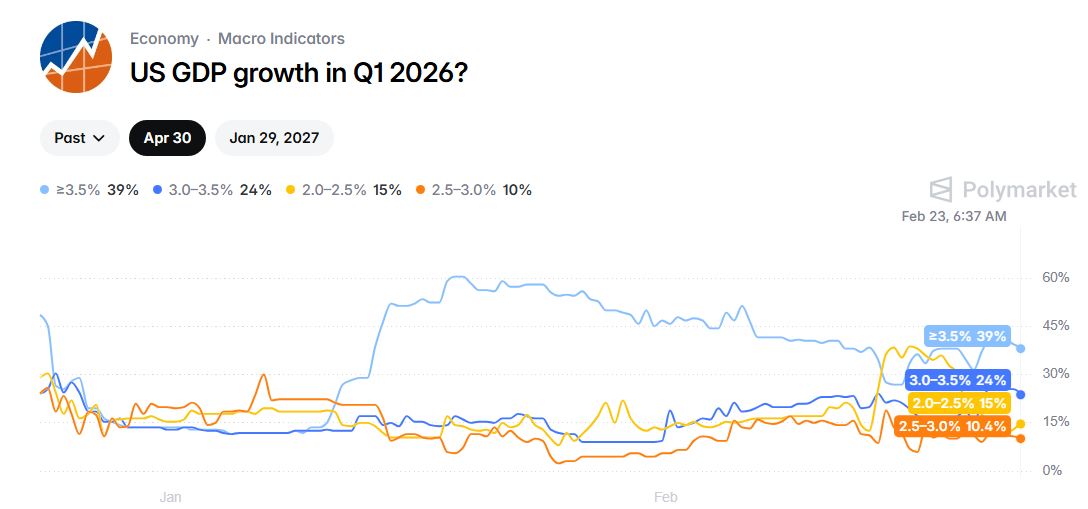
The initial nowcast for Q1 GDP points to a robust rebound, according to the Atlanta Fed’s GDPNow model, which is projecting a 3.1% increase. Sentiment in betting markets this morning is on board with the outlook: a 60% probability is currently priced in for Q1 growth of 3.0% or higher, according to Polymarket.

The economy may be stronger than it appears in the Q4 data, but uncertainty for trade policy spiked on Friday after the Supreme Court ruled that Trump’s import taxes were illegal. The President quickly countered that he would use another provision to impose a 15% tariff on all foreign goods coming into the country. But the whirlwind of trade‑policy news since Friday raises several questions that will take time to answer. Among the new issues raised:
* Trump’s new tariffs draw on authority from Section 122 of the Trade Act of 1974, but the provision limits how long tariffs can be imposed by the President — 150 days. Congress can extend the limit, but the unpopularity of tariffs in an election year looks like a hard sell for politicians seeking re‑election.
* Meanwhile, Trump said the administration will launch several investigations to address what it views as unfair trade practices by other countries and companies, drawing on the authority of Section 301 of the Trade Act of 1974.
Exactly how all this unfolds, and what it means for tariffs and trade, will remain a work in progress. One implication: the patchwork of trade deals the White House has negotiated with various countries now looks null and void as a sweeping, if temporary, 15% levy takes effect.
Meanwhile, the Supreme Court ruling on Friday implies that companies that paid tariffs over the past year are due refunds — $175 billion, by some estimates — a bill that would further deepen the federal government’s already steep budget deficit.
The more immediate threat for risk sentiment is the potential for a US attack on Iran. Trump is pressuring Iran over its nuclear program and has moved an array of military assets into striking range to intimidate Tehran. Talks between American and Iranian negotiators continue, but it’s not clear that Iran will capitulate — at least not to a degree that satisfies Trump.
In an interview on Sunday, Steve Witkoff, the President’s special envoy, said:
“I don’t want to use the word ‘frustrated’… because he [Trump] understands he’s got plenty of alternatives, but he’s curious as to why they haven’t… I don’t want to use the word ‘capitulated’, but why they haven’t capitulated. Why, under this sort of pressure, with the amount of sea power and naval power that we have over there, why haven’t they come to us and said, ‘We profess that we don’t want a weapon, so here’s what we’re prepared to do?’”
Some analysts fear that a US attack could trigger a wider regional conflict as Iran lashes out at its neighbors that host American military bases.
“For Iran, submitting to U.S. terms is more dangerous than suffering another US strike,” said Ali Vaez, the Iran director of the International Crisis Group. “They don’t believe that once they capitulate, the US will alleviate the pressure. They believe that would only encourage the US to go for the jugular.”
Markets now face a convergence of economic, legal, and geopolitical shocks that could easily destabilize sentiment if any one of them worsens. With growth slowing, trade policy in flux, and the risk of military escalation rising, the task of pricing in an uncertain future isn’t getting any easier.
Is Recession Risk Rising? Monitor the outlook with a subscription to:
The US Business Cycle Risk Report
Author: James Picerno