

AWS Weekly Roundup: AWS Nitro Sandboxes, AWS Emulator, and more (November 16, 2026)
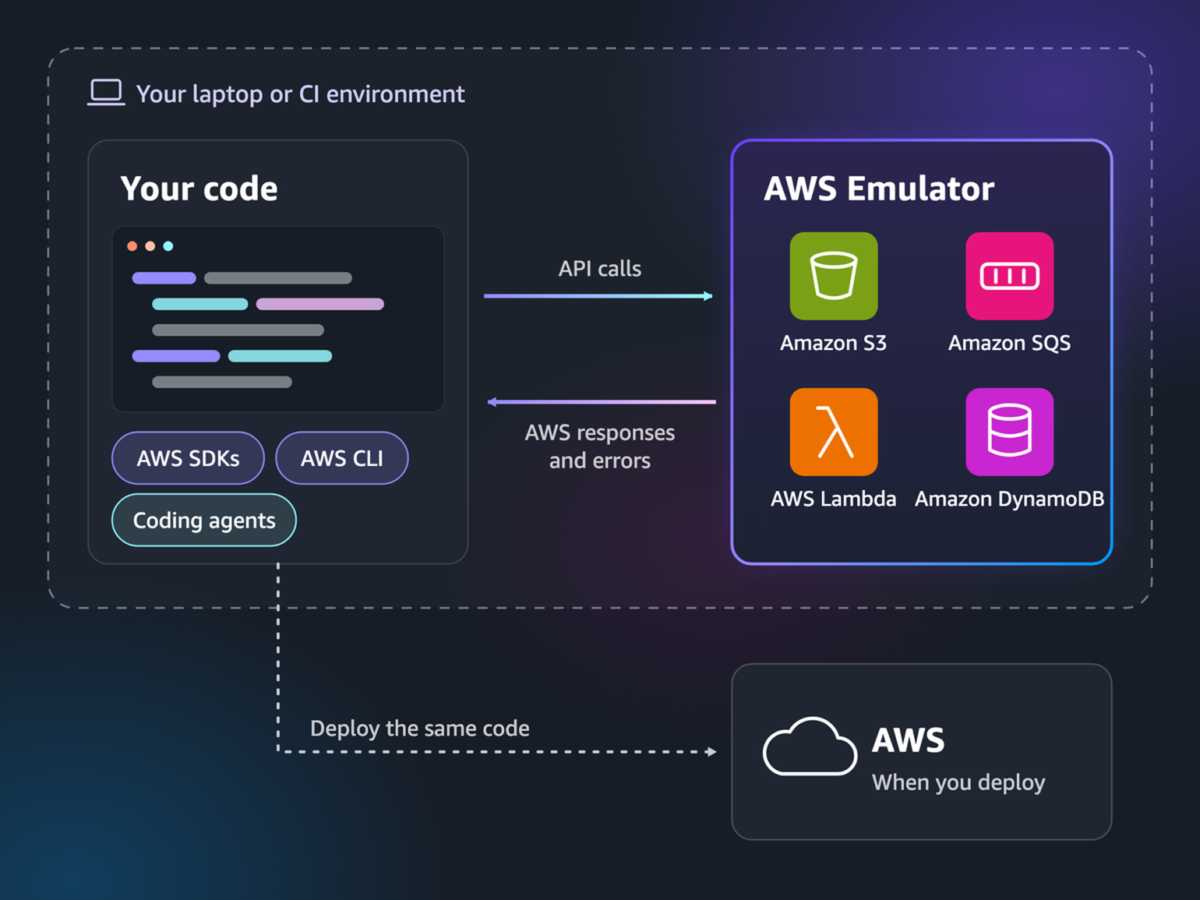
Last week’s launch of AWS Emulator brings part of that work onto your own machine: developers and coding agents can exercise AWS API interactions, inspect results, and try again without provisioning cloud resources for every attempt… There are also new ways to isolate workloads on shared infras…
A second delivery of the same message can reveal more about an application than its happy-path demo. I like tools that make those cases easier to investigate while a change is still small. Last week’s launch of AWS Emulator brings part of that work onto your own machine: developers and coding agents can exercise AWS API interactions, inspect results, and try again without provisioning cloud resources for every attempt.
I wrote about the Emulator’s launch last week, and it’s my main highlight in this edition. There are also new ways to isolate workloads on shared infrastructure, give an agent narrowly scoped access to a backend, and prepare search applications for a regional disruption. Now, let’s get into this week’s AWS news…
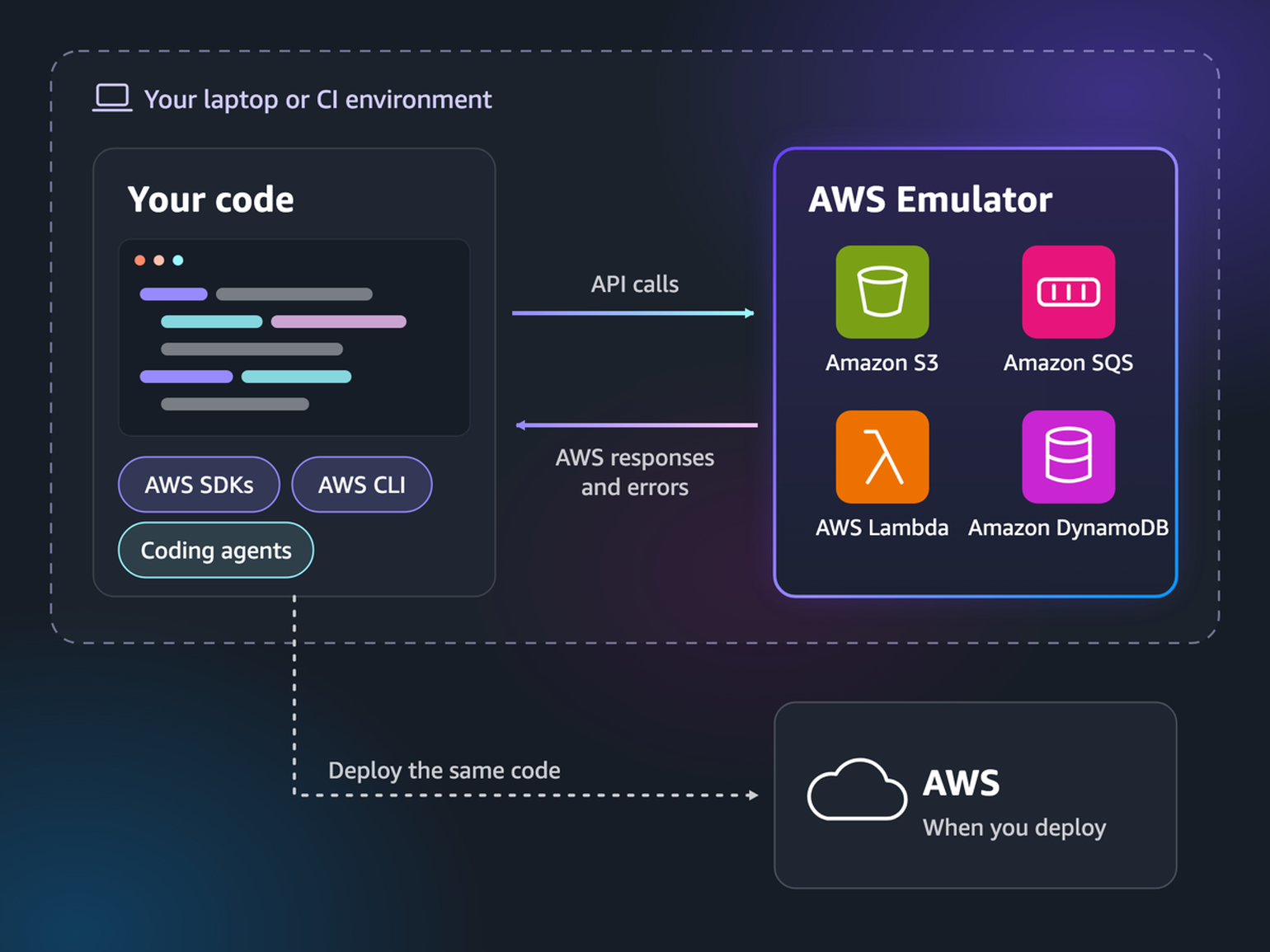
AWS Emulator runs locally alongside your code and development tools. Image: AWS.
Headlines
Test your applications against AWS locally with AWS Emulator introduces a generally available local environment for AWS API interactions. Point the AWS CLI or AWS SDKs at its HTTPS endpoint, and your application keeps its normal SDK calls. The walkthrough shows a coding agent creating an Amazon DynamoDB table, writing an item, and reading it back. You don’t need an AWS account for emulated operations, and there is no additional service fee. The getting-started guide covers Linux packages, Docker for macOS and Windows, and agent-assisted setup; the source is on GitHub.
What I like is giving an agent concrete feedback while it works: run calls, inspect results, and revise the code. Matt Wood’s perspective on feedback for coding agents explores why that loop matters. Check the published fidelity results for your operations, because coverage varies and unimplemented calls return HTTP 501. The emulator doesn’t reproduce IAM and resource-policy enforcement or cross-account and cross-Region behavior, so test the complete application and its security configuration on AWS before production.
AWS Nitro Sandboxes bring hardware isolation to pods, tasks, and VMs. You can give an Amazon EKS pod or Amazon ECS task its own VM boundary while sharing an Amazon EC2 instance. That is useful for tenant workloads, build jobs, and agents executing generated code. Isolated mode separates workloads from their neighbors; confidential mode adds protection from node operators and cryptographic attestation. The Compute Blog deep dive explains both modes and their integrations. Nitro Sandboxes have no additional charge on supported instances; EC2 and applicable EKS Auto Mode or ECS Managed Instances fees still apply.
Last week’s launches
Here are some launches and updates from this past week that caught my attention:
Amazon Cognito supports OAuth 2.0 token exchange – You can now exchange a user’s token for one scoped to a downstream service in Amazon Cognito. The derived token can have narrower permissions and a single audience, with no refresh token; supplying an actor token also identifies the intermediary in an act claim. For an agent calling a backend on someone’s behalf, that makes delegation more explicit without forwarding the original token. The feature is available on Essentials and Plus plans in all Cognito Regions.
Claude Fable 5.2 is available on AWS – You can access the model through Amazon Bedrock or Claude Platform on AWS. Anthropic positions it as its most capable generally available model for technical work, including extended engineering tasks, scientific research, and quantitative finance. Bedrock has model-specific retention requirements: Fable 5.2 traffic is retained for up to 30 days for abuse detection, with a temporary zero-retention exception for eligible internal use.
Amazon ElastiCache Serverless adds search and aggregations – You can now combine vector, full-text, and hybrid search with server-side aggregations in Amazon ElastiCache Serverless for Valkey. That gives product discovery, recommendations, and agent-memory retrieval another option for querying frequently changing data. The capability requires Valkey 9, so create a compatible cache or upgrade an existing one. It is available in commercial Regions, AWS GovCloud (US), and the AWS European Sovereign Cloud.
Amazon OpenSearch Service adds managed cross-Region disaster recovery – You can now pair Amazon OpenSearch Service domains running version 3.7 or later in two Regions within one account. AWS specifies recovery objectives under one minute for data loss and under 20 minutes for recovery time. Planned switchovers preserve all writes; unplanned failovers can lose unreplicated data. The deep dive covers the remaining work: keeping configuration aligned and redirecting application writes after switching roles, plus secondary-domain and data-transfer charges.
Amazon CloudWatch Logs adds account-level retention policies – You can now set retention across all log groups or groups matching a name prefix in Amazon CloudWatch, with policies covering existing groups or only new ones. When policies overlap, the longest retention period applies. A platform team can set a baseline and retain security logs longer without updating every group individually. The feature has no additional charge and is available in commercial Regions except Middle East (Bahrain) and Middle East (UAE).
The next generation AgentCore runtime is now the default – New Amazon Bedrock AgentCore runtimes now use the next-generation runtime by default, so agent sessions start in under 2 seconds, scale up to 8 vCPU and 32 GB, scale to zero when idle, and bill up to 68% less memory, while each session still runs in its own isolated microVM.
For a full list of AWS announcements, be sure to keep an eye on the What’s New with AWS page.
Other AWS news
Here are some additional posts and resources that you might find interesting:
Optimizing cost per task and proving agent ROI on Amazon Bedrock – This guide follows an agent’s cost through repeated calls, reasoning, caching, and human review. I like its emphasis on measuring a completed task and comparing outcomes against a documented baseline. Its worked prices are illustrative; use your own workload and reconcile estimated costs with billing data.
How Zillow runs 100 million daily notifications on AWS Step Functions – Zillow describes reusable content modules and configuration-driven AWS Step Functions Express Workflows for more than 100 million daily notifications. The useful engineering details include idempotent modules, batching, campaign isolation, and testing expressions with the TestState API before deployment. Those patterns apply well beyond notification systems.
Upcoming AWS events
Check your calendar and sign up for upcoming AWS events:
AWS re:Invent – Join the community in Las Vegas from November 30 to December 4. Browse more than 2,200 sessions, including workshops and deep dives, or register for the free livestream to follow keynotes and selected sessions remotely.
AWS Community Days – Find community-led technical talks, workshops, and hands-on learning near you. Check each organizer’s page for current dates and registration details.
Join the AWS Builder Center to connect with builders, share solutions, and access content that supports your development. Browse here for upcoming AWS-led in-person and virtual events and developer-focused events.
That’s all for this week. Check back next Monday for another Weekly Roundup!
– Daniel Abib
This post is part of our Weekly Roundup series. Check back each week for a quick roundup of interesting news and announcements from AWS!
Author: Daniel Abib