
Best Of Book Bits 2025: Part I
By purchasing books through this site, you provide support for The Capital Spectator’s free content… But you have to figure it out for yourself, because I don’t know you or your life experiences… I’m still trying to figure all this out for myself, too… How is spending money an art?A: …
Another year (nearly) over and so it’s time again to look back on the Book Bits columns of 2025 and highlight the volumes that caught your editor’s eye for one reason or another. As usual in this year-end review, we’ll feature ten books that appeared on these pages during the course of the year. We’ll start with five today, followed by the balance in a week. Happy reading!
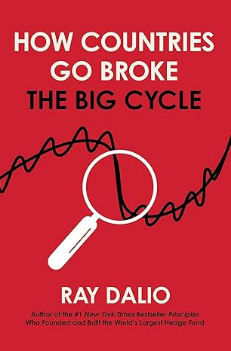 ● How Countries Go Broke: The Big Cycle
Ray Dalio
Review via Inc.
Billionaire investor Ray Dalio, who founded Bridgewater Associates, the largest hedge fund in the world, is warning that the debt situation in the United States is approaching a “death spiral” that could eventually threaten the entire U.S. economy.
In his new book, How Countries Go Broke: The Big Cycle, Dalio joins a growing chorus of financial experts and billionaires who have been sounding the alarm about government debt levels. The book comes as a report from the Congressional Budget Office released Wednesday found that Donald Trump’s budget bill would add $2.4 trillion to national debt, which currently stands at $36.9 trillion. The problem, Dalio said, is “urgent.”

● The Great Heist: China’s Epic Campaign to Steal America’s Secrets
David R. Shedd and Andrew Badger
Summary via publisher (HarperCollins)
Through a coordinated “whole-of-society” strategy, the Chinese Communist Party has dramatically expanded its covert operations to acquire America’s most valuable innovations—stealing defense secrets and proprietary technology from companies like Boeing, Lockheed Martin, Google, T-Mobile, and Tesla. By exploiting both human and cyber vulnerabilities, China has quietly looted the crown jewels of Western technology, saving itself trillions in R&D costs since the 1990s—with an ongoing brazenness fueled by decades of Western inaction. Drawing on exclusive investigations and interviews with intelligence officers, corporate security teams, senior policymakers, and espionage victims, David R. Shedd and Andrew Badger reveal how industrial theft has fueled China’s meteoric rise from Third World backwater to global superpower—and present a bold strategic playbook to turn the tide in the greatest economic contest of our time.

● 1929: Inside the Greatest Crash in Wall Street History–and How It Shattered a Nation
Andrew Ross Sorkin
Interview with author via CBS News
After nearly a decade spent studying the most famous stock market crash in history, financial journalist Andrew Ross Sorkin warns that the Wall Street of today echoes the market of 1929, when highs preceded a massive slump, leading to the Great Depression.
Artificial intelligence and technology have contributed to a remarkable boom in recent years. But, Sorkin said, today’s economy is being propped up by the AI boom, and it’s too soon to tell if this is a sugar rush, a short-term and unsustainable boost to the markets. But, Sorkin is positive there’s a crash coming.
“I just can’t tell you when, and I can’t tell you how deep,” he said. “But I can assure you, unfortunately, I wish I wasn’t saying this, we will have a crash.”

● The Art of Spending Money: Simple Choices for a Richer Life
Morgan Housel
Q&A with author via Kiplinger
Q: The title of your new book is The Art of Spending Money. How is spending money an art?
A: It’s an art because it’s not a science. I wish I could say, here’s how everybody should spend, but I don’t think a formula for how everyone should spend exists. The spending that works for me and makes me happy might be wrong for you, and vice versa. Some people might find that disappointing, that I’m basically giving an overview of the psychology of spending money. But you have to figure it out for yourself, because I don’t know you or your life experiences. I’m still trying to figure all this out for myself, too.

● The Mismeasurement of America: How Outdated Government Statistics Mask the Economic Struggle of Everyday Americans
Gene Ludwig
Review by Jared Bernstein via Washington Monthly
This duality between the data and how people experience the economy is the subject of The Mismeasurement of America, by Gene Ludwig, a former comptroller of the currency during the Clinton administration. Focusing on unemployment, wages, inflation, and the growing economic distance between Americans at the top and the bottom of the income scale, Ludwig argues that the problem is that the numbers I was touting were, if not quite wrong, then “profoundly misleading.” He then develops his own set of numbers, which he argues better explain why people have long felt a lot worse about the economy than you’d glean from the government’s top-line statistics. [Bernstein is the former chairman of the United States Council of Economic Advisers under President Joe Biden.]
Please note that the links to books above are affiliate links with Amazon.com and James Picerno (a.k.a. The Capital Spectator) earns money if you buy one of the titles listed. Also note that you will not pay extra for a book even though it generates revenue for The Capital Spectator. By purchasing books through this site, you provide support for The Capital Spectator’s free content. Thank you!
Author: James Picerno