

Bond Investors Embrace Maturity Risk In 2026
The pain is especially acute in the software industry, which is considered vulnerable amid rise of artificial intelligence… With nearly one‑fifth of BKLN’s portfolio exposed to software, the fund has taken a beating as the credit health of the industry has come under scrutiny…Investors …
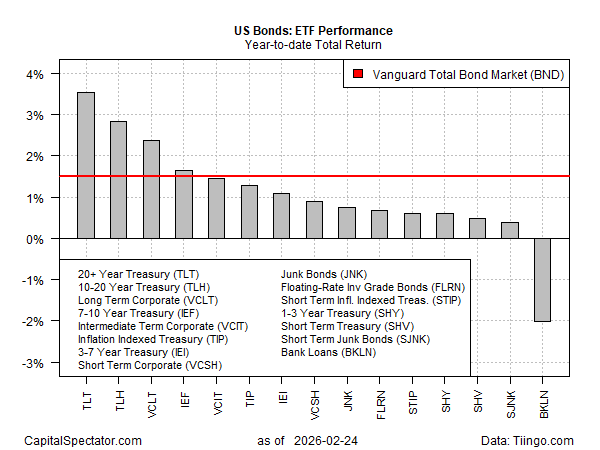
The risk appetite in the bond market has picked up this year as investors grow more comfortable with the economic outlook and the path of interest rates. A set of bond ETFs through yesterday’s close (Feb. 24) highlights a clear trend so far in 2026: favoring government securities with longer maturities has been a winning strategy.
Long‑dated Treasuries continue to lead by a comfortable margin year to date. The Vanguard Long‑Term Corporate Bond ETF (VCLT) is up 3.5% so far this year. In second place is the iShares 10–20 Year Treasury Bond ETF (TLH), posting a 2.8% year‑to‑date gain. On both counts, returns are far ahead of the U.S. investment‑grade fixed‑income benchmark, represented by the Vanguard Total Bond Market ETF (BND), which is up 1.5%.

The lone loser: bank loans (BKLN), which have slumped 2.0% this year. The ETF is getting hit amid heightened concerns about credit risk in leveraged loans. The pain is especially acute in the software industry, which is considered vulnerable amid rise of artificial intelligence. With nearly one‑fifth of BKLN’s portfolio exposed to software, the fund has taken a beating as the credit health of the industry has come under scrutiny.
Investors are asking: Does AI pose an existential crisis for software companies?
“The question is if [AI] agents and new platforms are interacting with existing software or replacing them,” says Jim Tierney, head of US growth investment at AllianceBernstein. “I’m leaning more to the former. What becomes the system of record for a business? It is unlikely to be a half dozen new vendors.”
As the crowd sorts out the answer, buying longer-dated Treasuries is in vogue. A key part of the reasoning is that inflation looks less threatening while the market is anticipating that the Federal Reserve will keep rates steady before resuming cuts in June, based on Fed funds futures. Add in the slowdown in economic growth and a downshift in hiring and conditions have been supportive for taking more risk in government bonds.
If one or more of those pillars shifts, the surge in the risk appetite for Treasuries could stumble. Fiscal risk is another potential source of anxiety for government bonds vis-à-vis a worrisome outlook for an already hefty federal budget deficit.
For the moment, however, the party continues as the bond market goes all-in on long Treasuries.

Author: James Picerno