

Book Bits: 10 January 2026
By purchasing books through this site, you provide support for The Capital Spectator’s free content… It is often started out of personal hubris or blind patriotic zeal: think of Napoleon’s invasion of Russia or Japan’s decision in 1941 to provoke a war with a superpower it could not hope to…
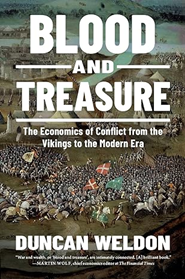
 ● Blood and Treasure: The Economics of Conflict from the Vikings to the Modern Era
Duncan Weldon
Review via The Economist
Of all human activities, war is the least rational. It costs a fortune. It spreads death and misery, from the killing fields of Sudan to the tunnels of Gaza. It is often started out of personal hubris or blind patriotic zeal: think of Napoleon’s invasion of Russia or Japan’s decision in 1941 to provoke a war with a superpower it could not hope to defeat. So you might think economics—a discipline associated with rational self-interest—would have little to say about it. You would be wrong, argues Duncan Weldon, a former writer for and occasional contributor to The Economist, in “Blood and Treasure”.
 ● Ruthless: A New History of Britain’s Rise to Wealth and Power, 1660-1800
Edmond Smith
Summary via publisher (Yale U. Press)
Was Britain’s industrial revolution the result of its machines, which produced goods with miraculous efficiency? Was it the country’s natural abundance, which provided coal for its engines, ores for its furnaces and food for its labourers? Or was it Britain’s colonies, where a brutalized enslaved workforce produced cotton for its factories? Acclaimed historian Edmond Smith shows how the world’s first industrial nation was founded on the ruthless exploitation of technology, people and the planet. This economic system linked the plantations of the Caribbean with the colossal cotton mills of northern England, applied the innovations of science and agriculture to colonial exploration, and formalised financial markets in self-serving ways. At the heart of these processes were Britons themselves, early capitalists who spun webs of expertise and investment to connect exploitative practices across the globe.
 ● The Permanent Problem: The Uncertain Transition from Mass Plenty to Mass Flourishing
Brink Lindsey
Review via The Unpopulist
As in the 1970s, some of the sharpest criticism—and certainly the most intelligent—comes from inside the house: distinguished liberal thinkers like Francis Fukuyama, William Galston, and James Davison Hunter. Arriving to join them is Brink Lindsey of the Niskanen Center, a Washington think-tank. Once a scholar at the libertarian Cato Institute, Lindsey remains within the liberal camp but has strayed from neoliberal orthodoxy. Just how far is apparent in his new book, The Permanent Problem: The Uncertain Transition from Mass Plenty to Mass Flourishing.
Lindsey begins with a famous challenge framed by the economist John Maynard Keynes in his 1930 essay “Economic Possibilities for Our Grandchildren.” “For the first time since his creation,” Keynes wrote, “man will be faced with his real, his permanent problem—how to use his freedom from pressing economic cares, how to occupy the leisure which science and compound interest will have won for him, to live wisely and agreeably and well.”
 ● If Russia Wins: A Scenario
Carlo Masala
Review via Financial Times
Masala portrays European leaders as naive, short-sighted and divided. Only the German chancellor stands out — but in isolation. France is under far-right rule and has turned its back on Berlin. The UK prime minister is a good guy, though makes rare, largely inconsequential appearances — an unfair characterisation, perhaps, given current realities.
The result is a well-informed — albeit a tad German-centric — script on how autocracies could prevail, that could inspire a film in the mould of Dr Strangelove, though without the humour of Stanley Kubrick’s 1964 dark comedy about the world’s descent into nuclear annihilation.
Please note that the links to books above are affiliate links with Amazon.com and James Picerno (a.k.a. The Capital Spectator) earns money if you buy one of the titles listed. Also note that you will not pay extra for a book even though it generates revenue for The Capital Spectator. By purchasing books through this site, you provide support for The Capital Spectator’s free content. Thank you!
Author: James Picerno