

Book Bits: 4 January 2026
By purchasing books through this site, you provide support for The Capital Spectator’s free content… ● Capital Evolution: The New American Economy Seth Levine and Elizabeth MacBride Summary via publisher (Simon & Schuster) In Capital Evolution: The New American Economy, Seth Levine and El…
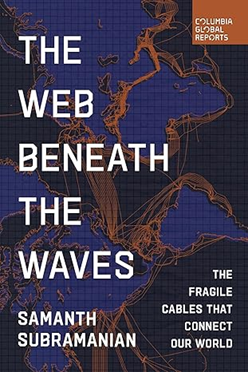
 ● The Web Beneath the Waves: The Fragile Cables that Connect our World
Samanth Subramanian
Review via Los Angeles Review of Books
Nearly twenty years ago, during a congressional debate over net neutrality, Senator Ted Stevens of Alaska described the internet as a “series of tubes.” The remark became an instant meme, a rhetorical relic that suggested an antediluvian age when telecommunications depended on switchboard operators, wires, and cables.
In retrospect, Stevens’s statement was far from absurd. For, as Samanth Subramanian’s excellent new book The Web Beneath the Waves: The Fragile Cables That Connect Our World makes clear, the internet does indeed consist (at least in part) of a vast network of glass tubes—fiber-optic cables. We think of the internet as an abstraction, a view reflected in the lexicon of the data economy—the cloud, AirDrop, even the Ethernet cable. But, though cyberspace may be virtual, it relies on earthly infrastructure. The apparent weightlessness of the internet depends on very physical cables, the most important of which run deep under the world’s oceans. Ninety-nine percent of the world’s data zips through these filaments, which are only three inches wide. These threads on the seafloor are the world’s information superhighways. They are also tremendously fragile, exposed to natural disaster, marine accident, and sabotage. Indeed, the most vulnerable part of the global data infrastructure may well be the part that has been submerged.
 ● The Future After AI: Expectations for Artificial Intelligence as the New Operating System of Finance, Technology, Energy, Healthcare, Education, and Business
Jason Schenker
Press release for book
In The Future After AI, Jason Schenker explains how AI is shifting from a surprising new technology to the quiet bedrock powering finance, energy, technology, healthcare, education, business, cities, and national security. Schenker explores how AI is transforming the global economy in ways as profound as the internet and computers once did. But just as we no longer marvel at using the internet, AI’s impact is likely to become so deeply embedded in technology and society that we might soon stop talking about it at all. Through data-driven analysis, forward-looking scenarios, and insights drawn from his work advising global companies, investment firms, and governments, Schenker reveals how AI will redefine productivity, reshape power structures, and become an invisible core part of the way the world works. The future will be AI-enabled, AI-integrated, and AI-invisible.
 ● Capital Evolution: The New American Economy
Seth Levine and Elizabeth MacBride
Summary via publisher (Simon & Schuster)
In Capital Evolution: The New American Economy, Seth Levine and Elizabeth MacBride deliver a bold and timely reassessment of capitalism in America. Drawing on decades of experience in finance, journalism, and policy, Levine and MacBride argue that capitalism isn’t the problem—it’s the outdated neoliberal version we’ve been practicing that’s failing us. From the rise of populism to the growing disillusionment among younger generations, the signs of strain are everywhere. But Levine and MacBride reveal how a new consensus—what they call Dynamic Capitalism—is already taking shape, one that balances profit with purpose, empowers the middle class, and addresses the urgent challenges of inequality and climate change.
Please note that the links to books above are affiliate links with Amazon.com and James Picerno (a.k.a. The Capital Spectator) earns money if you buy one of the titles listed. Also note that you will not pay extra for a book even though it generates revenue for The Capital Spectator. By purchasing books through this site, you provide support for The Capital Spectator’s free content. Thank you!
Author: James Picerno