

Commodities Surge, Everything Else Sinks as Iran War Drags On
28, nearly every major asset class—aside from commodities and cash—has slipped into the red, with losses spreading broadly across global markets through yesterday’s close (Mar…Let’s start with the upside outlier: commodities…7% since the war began, sparked by soaring energy costs …
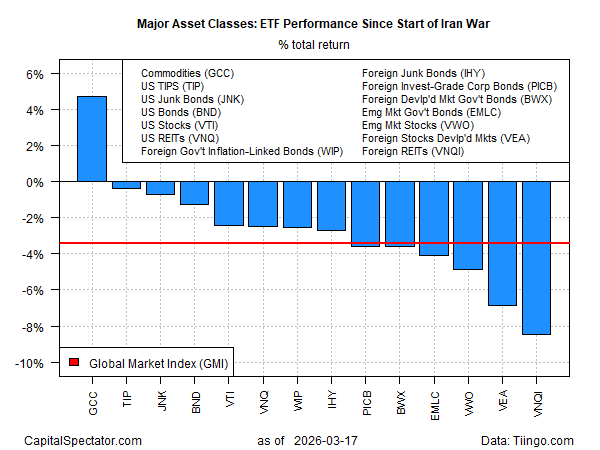
The pain isn’t equally distributed. It never is, as the fallout from the war in Iran makes clear. Since the attack began on Feb. 28, nearly every major asset class—aside from commodities and cash—has slipped into the red, with losses spreading broadly across global markets through yesterday’s close (Mar. 17).
Let’s start with the upside outlier: commodities. A broad measure of raw materials (GCC) has surged 4.7% since the war began, sparked by soaring energy costs as the conflict restricts oil and natural gas exports from the Persian Gulf region — a supply shock that’s spilled over into other commodities.

In stark relief with the singular rise of commodities since the war’s start, there are many losers. Foreign property shares are posting the deepest decline so far: Vanguard Global ex-US Real Estate (VNQI) has shed 8.5%.
That compares with a 2.4% drop in U.S. stocks (VTI) and a 1.3% slide for U.S. bonds (BND) during the war’s blowback to date. Notably, inflation-indexed Treasuries (TIP) are posting the strongest relative performance (excluding commodities). The near-flat performance for the iShares TIPS Bond ETF is likely a market reaction to concerns that the war could spark higher inflation for some period of time.
A Consensus Economics poll last week reports that analysts have lifted their inflation forecast for this year for most of the G7 and Western European countries compared with estimates in February, the FT reports.

The main question for investors: when will the war end? The optimistic view is that energy costs will fall sharply once the fighting stops and blocked exports of crude oil and natural gas start flowing again. But with no sign of an endgame in sight at the moment, the war’s trajectory remains foggy, which in turn will keep markets guessing about the near-term outlook for risk assets.
Some experts think this could be over soon, perhaps days, if diplomacy kicks in or Iran keeps losing steam. But the US is reportedly planning for the conflict to run through the late summer or even fall, so a longer fight in some form is on the table as a possibility, however remoted. The raw calculus boils down to how much more Iran can take, how long the US and Israel want to keep at it, and whether everyone can agree on a deal before things get too expensive and messy.
The key dynamic is bound up with how the S and Iran view the conflict, and how that will influence decisions on the war’s duration.
“The United States and Israel want a quick and decisive victory,” says Mehran Kamrava, Professor of Government at Georgetown University in Qatar. “For Iran, simply resisting and surviving is victory.”
“What we see are two different logics at work here,” he adds. “The United States and Israel measure success through visible military damage. Iran sees this as a prolonged conflict. It is a war in which, over time, Iran would grind down American and Israeli resolve. The question is who is going to blink first.”
Learn To Use R For Portfolio Analysis
Quantitative Investment Portfolio Analytics In R:
An Introduction To R For Modeling Portfolio Risk and Return
By James Picerno
Author: James Picerno