

Energy Stocks Lead This Year, But Tech Still Drives the S&P 500
The US stock market is on track for a fourth consecutive year of double-digit gains, but the sector leading the performance race is not necessarily driving the market… Yet tech remains the primary force behind the S&P 500’s advance because it carries a much larger weight than energy in the m…
The US stock market is on track for a fourth consecutive year of double-digit gains, but the sector leading the performance race is not necessarily driving the market. Energy stocks have been the standout performers in 2026, soaring far ahead of every other sector, including technology. Yet tech remains the primary force behind the S&P 500’s advance because it carries a much larger weight than energy in the market-cap-weighted index.
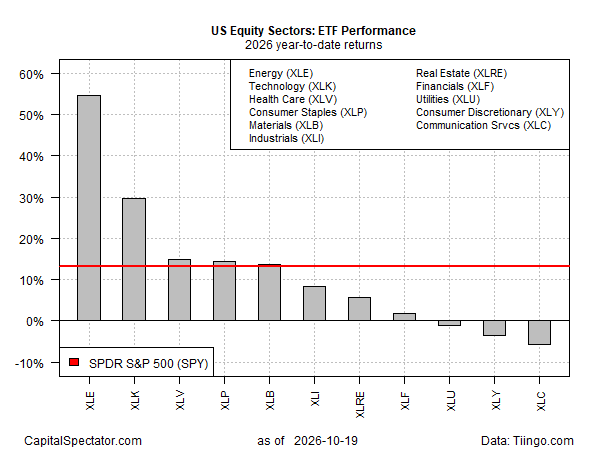
The market, in other words, is still heavily dependent on technology, a.k.a. artificial intelligence (AI). That may not be obvious when comparing year-to-date results across the S&P 500’s sectors, based on a set of ETFs through Monday’s close. Clearly, energy stocks (XLE) have been far and away the leader in 2026, surging nearly 55% year to date. Technology (XLK) is a distant second with a 29.6% gain. Both funds are well ahead of the market benchmark’s 13.3% gain in 2026, as measured by the SPDR S&P 500 ETF (SPY).
Despite trailing energy by a wide margin in performance this year, the AI-powered technology sector remains the biggest contributor to the S&P 500’s advance. The key is market capitalization. Because the index is market-cap-weighted, technology’s enormous footprint gives it far more influence over the benchmark than energy. Although the energy sector is home to several oil behemoths, they pale beside the trillions of dollars in value that Big Tech has added in recent years amid the AI boom.
The SPDR S&P 500 ETF (SPY) currently has a tech weight of nearly 39%, acccording to Morningstar.com. Energy is relatively insignificant with a 3.8% weight.
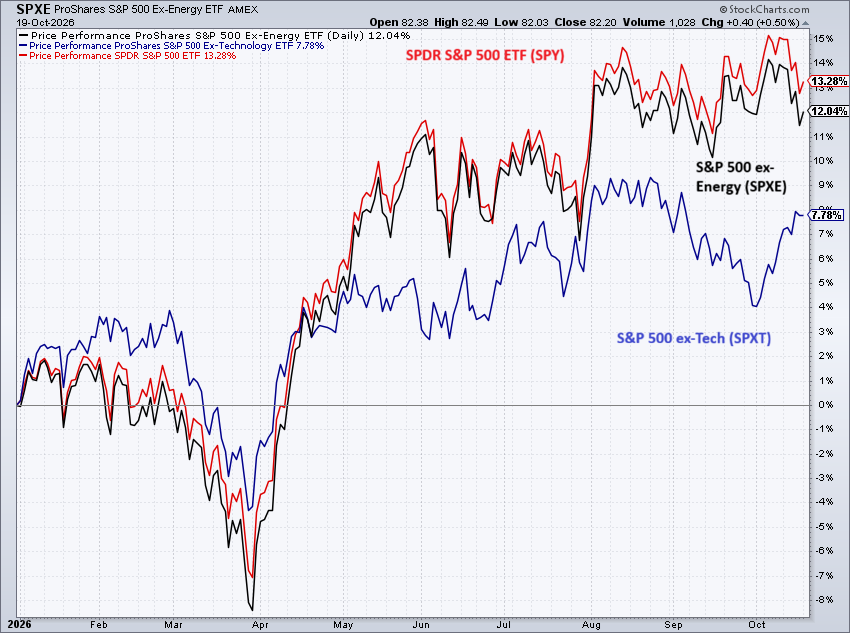
For a clearer view of how energy and technology have influenced the S&P 500 this year, consider two S&P 500 ETFs: one that excludes energy (SPXE) and another that excludes tech (SPXT). Removing energy has only a modest effect on performance, with SPXE (black line in the chart below) returning 12.0% year to date versus 13.3% for a standard S&P 500 ETF (red line). Despite energy’s powerful rally, its relatively small weight in the index limits its impact on the benchmark’s overall return. By contrast, removing technology produces a much weaker result, underscoring the sector’s outsized role in driving the market’s gains this year.
The main takeaway: technology is still the dominant force in the stock market. That’s another way of saying that the AI theme remains the market’s critical influence. As long as investors remain confident that AI can drive faster revenue growth, wider profit margins, and new business opportunities, technology stocks are likely to remain the market’s cornerstone and a key pillar of the current bull market.
That doesn’t guarantee a smooth ride in the months ahead. Valuations for many AI-linked companies remain elevated, leaving little room for disappointment. But for now, corporate earnings continue to support the theme, at least on rear-view mirror basis, with technology firms still delivering some of the strongest growth rates in the S&P 500.
John Butters at FactSet reports that “the ‘Magnificent 7’ companies have reported higher year-over-year earnings growth than the other 493 companies in the S&P 500 over the past several quarters.”
Energy may be winning the performance race in 2026, but technology remains the market’s engine.
The more pertinent question is whether we’re beginning to see signs that AI’s earnings advantage is peaking, at least in relative terms. Possibly. As Butters notes: “the ‘Magnificent 7’ companies will report lower (year-over-year) earnings growth than the other 493 S&P 500 companies for Q4 2026 (23.6% vs. 30.6%). If these are the actual growth rates for the quarter, it will mark the first time the ‘Magnificent 7’ companies will have reported lower earnings growth than the other 493 S&P 500 companies since Q4 2022 (-30.6% vs. 1.6%).”
For context on how the overall market vibe may be shifting, keep an eye on XLK’s price trend as a potential early warning signal.
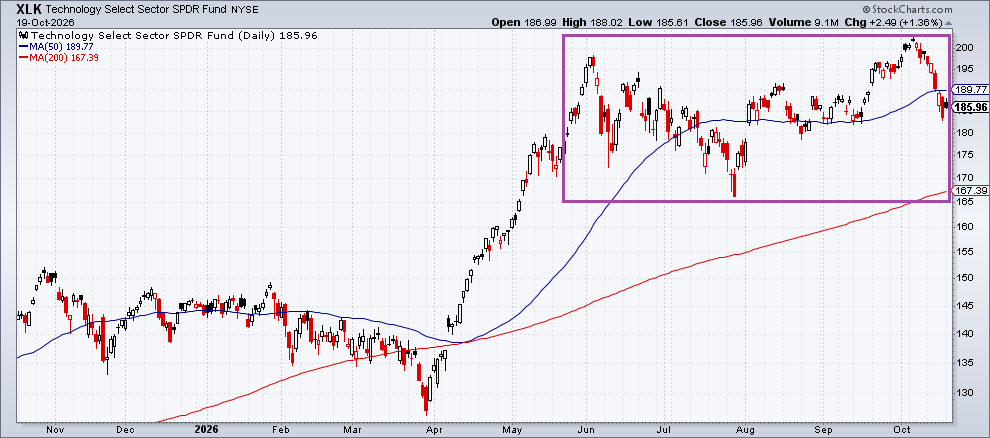
The ETF has been trading in a range recently. One view is that the sector is merely consolidating recent gains and laying the groundwork for another move higher. Perhaps. But if the fund tests and then breaks below its recent low, around $167, that could signal that investor sentiment is beginning to shift. Such a move would not necessarily mark the end of the AI trade, but it would raise new questions about whether the market’s dominant leadership group is losing some of its momentum. That could be an issue for a sector that’s more or less priced for perfection.
For now, however, the evidence still points in one direction: technology remains the sector most likely to determine whether the bull market keeps running. Whether that’s still a net plus may come under new scrutiny in the months ahead.

Author: James Picerno