

Fed Minutes Signal More Tightening Amid Mixed Inflation Data
The Federal Reserve appears poised to raise interest rates again to keep inflation in check, but exactly when remains uncertain, according to minutes from its Sept… Investors continue to price in another hike, although mixed inflation signals are muddying the outlook…” Analyzing those risks is…
The Federal Reserve appears poised to raise interest rates again to keep inflation in check, but exactly when remains uncertain, according to minutes from its Sept. 15-16 meeting. Investors continue to price in another hike, although mixed inflation signals are muddying the outlook.
“With regard to the outlook for monetary policy beyond the current meeting, most participants assessed that another increase in the target range for the federal funds rate would likely be appropriate by year end,” the minutes report. “Participants emphasized, however, that they approached each meeting with an open mind and decisions at future meetings would depend on incoming information and its implications for the outlook and the balance of risks.”
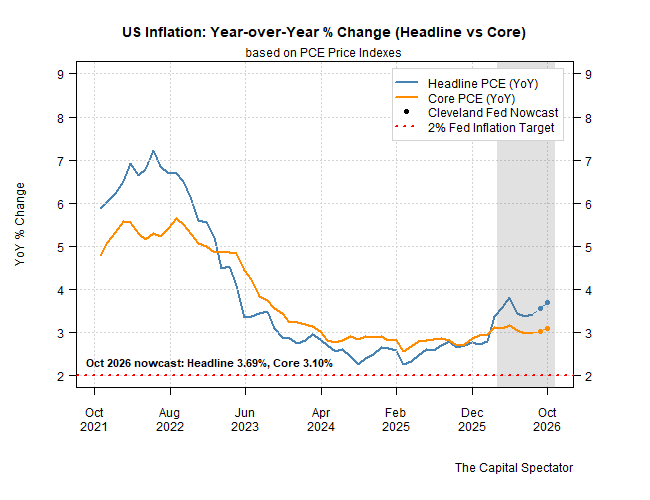
Analyzing those risks is especially challenging lately amid mixed signals on the strength and direction of inflation. Headline and core readings of the Personal Consumption Expenditures (PCE) price index, the Fed’s preferred inflation benchmarks, have been running above the central bank’s 2% target for more than five years, prompting concerns that tighter policy may be needed to bring inflation down.
The Cleveland Fed’s nowcasts indicate that PCE inflation will edge higher on a year-over-year basis in September and October.
A key challenge for the Fed is deciding whether hotter headline PCE inflation should prompt additional rate hikes at a time when core PCE is cooler and showing a softer upward bias. This is a tricky issue for monetary policy. Core measures of inflation, which exclude certain volatile categories such as food and energy, are viewed by many economists as a more reliable gauge of the underlying trend. But headline inflation is generally more relevant for consumers and businesses.
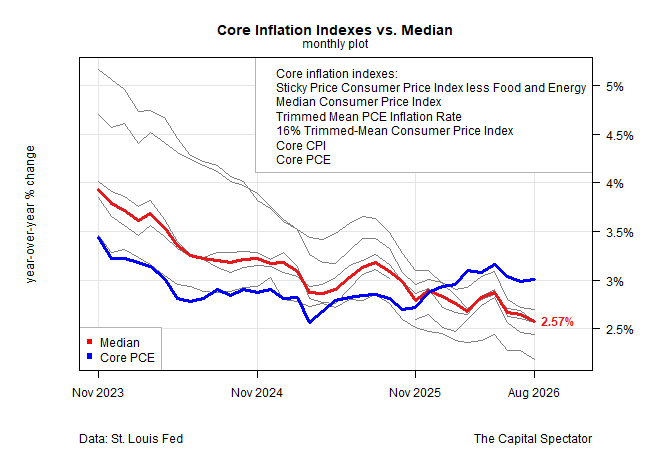
An additional layer of complexity is that alternative measures of core inflation are sending mixed signals. The one-year trend for core PCE remains sticky at a pace above 3%, which suggests policy tightening is appropriate. But other core metrics point to slower and gradually easing inflation, as shown in the chart below.
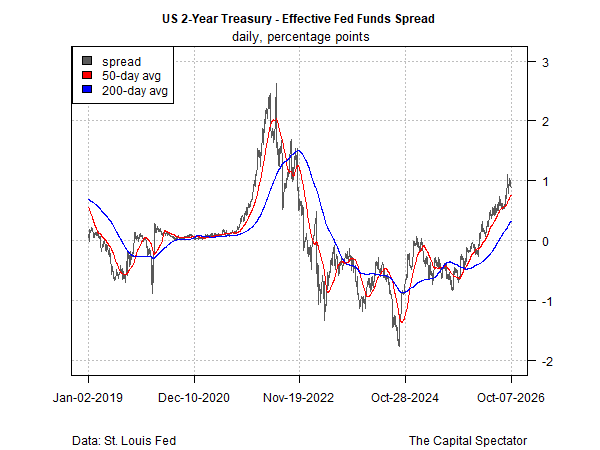
How much of this nuance matters to financial markets is debatable, but for now the bond market continues to price in an ongoing hawkish tilt. The policy-sensitive 2-year Treasury yield, which is widely followed as a market proxy for the Fed’s rate outlook, continues to trade well above the current policy rate. Notably, the spread between the 2-year yield and the effective federal funds rate, the average interest rate at which banks lend reserve balances to one another overnight and the Federal Reserve’s primary policy rate, continues to widen. Although this spread (89 basis points as of Oct. 7) has eased recently, the broader trend remains upward, suggesting that investors continue to price in higher odds of tighter policy in the near term.
Fed funds futures this morning are pricing in roughly an 80% probability that the Fed will leave its target rate unchanged at the next FOMC meeting on Oct. 28, but a rate hike is still considered highly likely in December.
“Many participants emphasized that a higher path for the target range would be prudent on risk-management grounds, providing insurance against inflation remaining persistently above target due to stronger-than-expected demand or further adverse supply shocks,” the latest minutes advise.
The Fed may be debating the timing, but markets are increasingly focused on the direction. On that front, bond yields and inflation nowcasts continue to point toward a higher-for-longer policy path. The next opportunity for an attitude adjustment is due next week (Oct. 14), when the government updates consumer price data, which will offer an early look at how pricing pressure evolved in September.
Is Recession Risk Rising? Monitor the outlook with a subscription to:
The US Business Cycle Risk Report
Author: James Picerno