

How a global payment processor preserved AWS RAM shares and Lake Formation permissions during an AWS Organizations migration
The moves take more care when AWS Resource Access Manager (AWS RAM) resource shares are involved… An organization-bound share trusts an account through its organization membership, so when the account leaves, AWS RAM removes that association… Anything in production that depends on a shared res…
Accounts move between organizations in AWS Organizations whenever a business changes shape. A merger folds one estate into another. A divestiture carves one out, and some companies run more than one organization by design.
The moves take more care when AWS Resource Access Manager (AWS RAM) resource shares are involved. An organization-bound share trusts an account through its organization membership, so when the account leaves, AWS RAM removes that association. Anything in production that depends on a shared resource needs a continuity plan before the first account moves.
A leading worldwide provider of payment technology and software solutions, based out of the United States, used temporary AWS RAM resource shares to preserve AWS Lake Formation permissions during an AWS Organizations migration of 382 AWS accounts. The payment processor serves merchants and financial institutions around the world. The program separated them from their former parent company, a US-headquartered financial technology provider serving banking and capital markets clients globally, before a Transitional Service Agreement (TSA) expired in April 2026.
The migration unfolded alongside wider corporate change. In January 2026, the payment processor was acquired by a leading payments technology company headquartered in the United States. The transaction transforms the acquirer into a pure-play commerce solutions provider, serving the full spectrum of clients from small businesses to global enterprises worldwide. The migrating estate also included the payment processor’s embedded payments platform, a US-based provider of embedded payment and automated onboarding tools for software-as-a-service (SaaS) platforms.
Most workloads kept running when the original organization-bound shares broke, but the control plane lost access. They needed a migration pattern that preserved service continuity without leaving temporary permissions behind.
AWS partnered with them to design and validate that pattern in two weeks. It uses retained bridge shares for the move, then restores the original shares as the durable permission objects.
In this post, we explain why the bridge works, why the original share must return, and how the company applied the pattern at enterprise scale. For command-level implementation, see Transfer AWS accounts between AWS Organizations while preserving AWS Lake Formation permissions and aws-samples/sample-aws-ram-org-migration.
Solution overview
An AWS account can consume a resource to share automatically while it belongs to the same organization as the producer. When the account leaves, AWS RAM removes that organization-bound principal association. Creating a retained bridge share as an external association before the move preserves access through the organization’s change.
After the move, the company restores the migrated account to the original share, verifies access, and removes the bridge. The original share remains the AWS Lake Formation-managed source of truth. New grants and resource changes continue to attach to it, not to the point-in-time bridge copy. Keeping both would create duplicate permission state and drift.
The following diagram shows the migration wave structure.
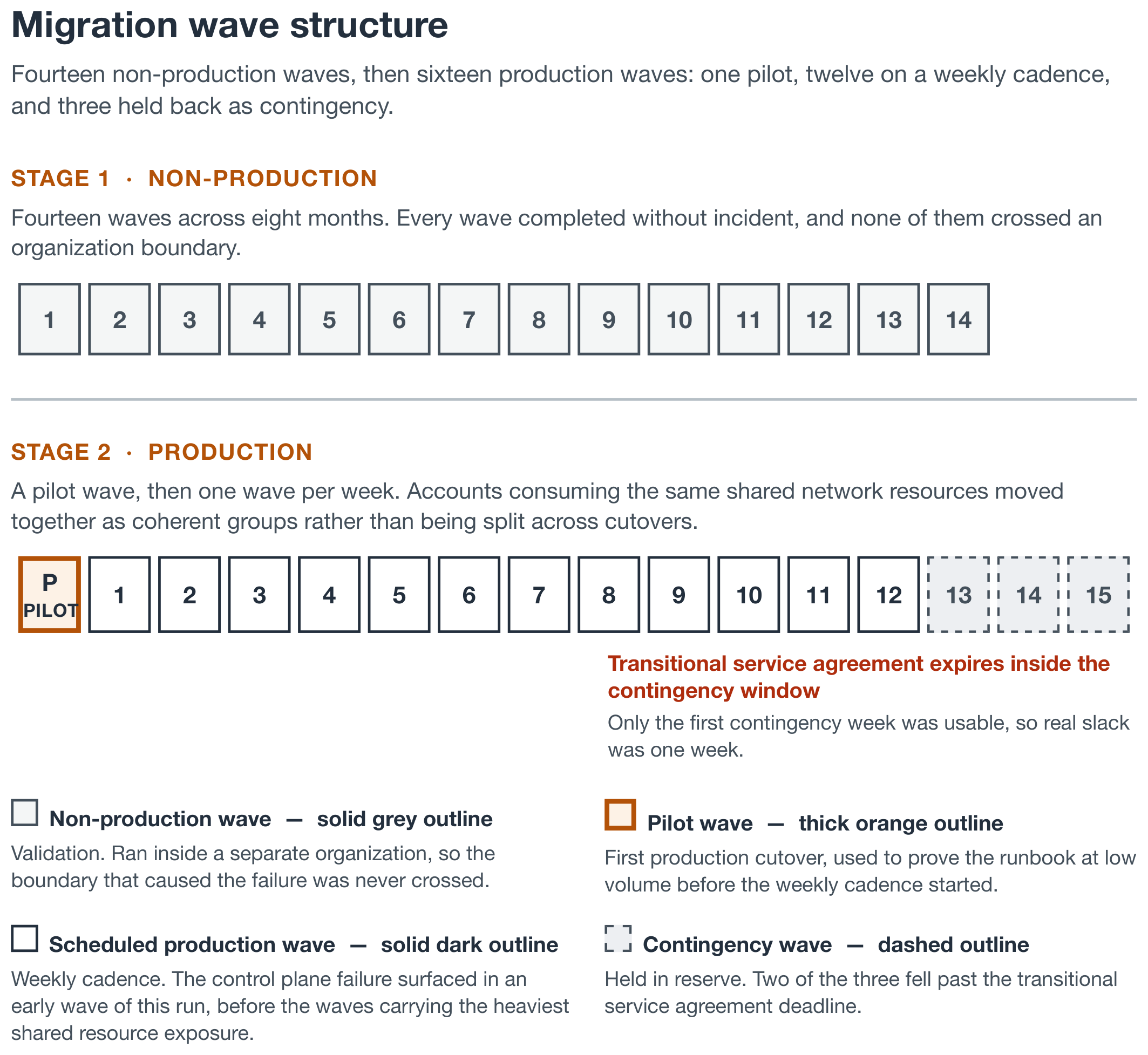
The company’s cloud engineering team ran 14 non-production waves, a production pilot, 12 weekly production waves, and three contingency waves. The TSA expired inside the contingency window, leaving about one week of usable slack.
Challenge
The risk surfaced in a production wave in February 2026. A terraform apply against a shared AWS Transit Gateway failed with a permission error, although traffic kept flowing and no alarm fired.
This was a control plane failure. Existing attachments, DNS paths, and certificates continued to work, but engineers could not change shared resources. The dedicated AWS Transit Gateway, Amazon Route 53 Resolver, and the embedded payments platform’s AWS Glue Data Catalog waves were still ahead.
Why the issue stayed hidden
Most services retain their data plane when an AWS RAM association breaks. For example, an Amazon Elastic Compute Cloud (Amazon EC2) instance in a shared Amazon Virtual Private Cloud (Amazon VPC) keeps running, but the account cannot launch a new instance. Infrastructure-as-code exposed the problem because it needed control-plane access.
The following table summarizes the affected resource types confirmed by the customer.
| Resource | AWS service | Effect of losing the share |
| AWS Transit Gateway | ec2:TransitGateway | Loses control plane access, keeps the data plane |
| Amazon Route 53 Resolver rules | route53resolver:ResolverRule | Risk of DNS resolution disruption |
| AWS Private Certificate Authority (AWS Private CA) | acm-pca:CertificateAuthority | Loses the share, issued certificates keep working |
| Amazon EC2 prefix lists | ec2:PrefixList | Keeps the data plane, blocks new resource creation |
| AWS Glue Data Catalog databases and tables | AWS Glue and AWS Lake Formation | Requires bridge-share validation before migration |
Some services require additional handling. Depending on its resource-cleanup configuration, an AWS Firewall Manager policy can remove AWS Network Firewall rules, which you must then redeploy, and organization-integrated AWS CloudFormation StackSets can delete stacks unless you set them to retain.
The embedded payments platform initially entered the estate through an acquisition by the former parent company. Its embedded payment and automated onboarding capabilities were subsequently integrated into the payment processor’s ecosystem to support a broader platform-focused offering for SaaS providers. The platform shared databases and tables across 10 accounts with account IDs as principals, and the workstream was paused rather than testing the migration against production.
Why the original shares broke
The company had enabled sharing with AWS Organizations in the producer account. AWS RAM therefore trusted each in-organization principal through organization membership, even when a share named an account ID. When an account left the source organization, AWS RAM removed that organization-bound association.
A share created for a principal outside the organization behaves differently. AWS RAM sends an invitation, and the accepted association is external. Because it does not depend on organization membership, it survives the account move. The bridge-share pattern uses this behavior.
Why non-production testing missed it
The company’s non-production accounts were already in a separate organization. They never crossed the boundary that caused production associations to break.
Fourteen clean waves validated the migration process but not the production-only condition. Each validation environment must cross the same trust boundary as production.
Applying the bridge-share pattern
This failure was raised with the AWS account team, which brought AWS RAM, AWS Glue, AWS Lake Formation, and AWS Organizations service teams into the response. The company first used a manual recovery path for 21 accounts while the teams automated a scalable approach.
On February 27, 2026, AWS released RetainSharingOnAccountLeaveOrganization for new AWS RAM resource shares. The setting marks principals as external after they accept the invitation. The customer confirmed that the setting does not retrofit existing shares, so those shares needed a temporary parallel share.
Retaining access during the move
AWS RAM allows a resource to belong to more than one resource share, so a parallel share can exist alongside the original. A second retained share was created alongside each original, targeting the same consumer account.
The consumer accepted the invitation before migration, creating an external association. During the move, AWS RAM removed the original organization-bound association while the bridge continued to grant access. AWS Organizations also support transferring an account directly between organizations, so the move itself does not require an intermediate standalone period.
Why restore the original share?
The bridge is a migration-only continuity copy. The original AWS Lake Formation-created share remains the durable, service-managed permission object. If a team adds a grant or changes a shared resource during the migration window, that change applies to the original share, not automatically to the bridge.
The company therefore restored migrated principals to the original share before deleting the bridge. Leaving both in place would create two permission paths that can diverge, complicate audits, and conceal which share is authoritative.
Automation deletes a bridge only after it finds a non-bridge original whose resources, principals, and permissions cover the bridge and whose associations are all ASSOCIATED. This check confirms the original share’s associations are active before removing the temporary path. Access and connectivity were validated separately, as described in the Outcome section.
Validated workflow
AWS validated the pattern across three test accounts and two organizations before it was used in production. Testing confirmed that allowExternalPrincipals alone was not enough. The bridge also required retainSharingOnAccountLeaveOrganization.
The following diagram shows the bridge before and after the account move.
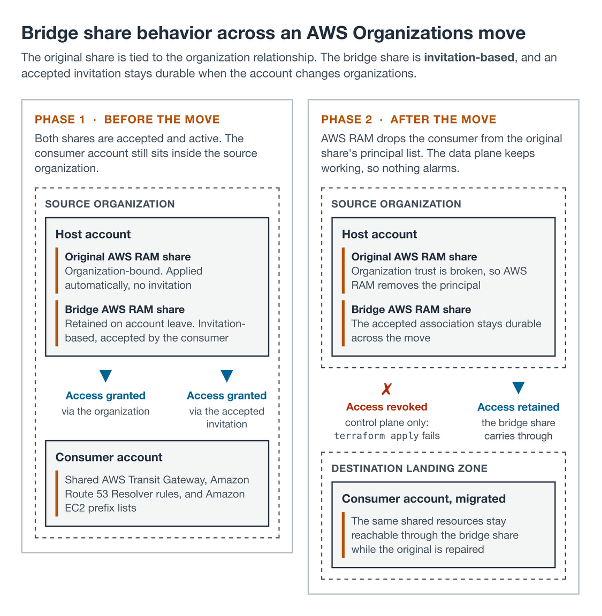
Each production wave used five steps:
- Inventory. Map each original share, resource, principal, permission, and Region. AWS RAM is Regional, so repeat the inventory in every in-scope Region.
- Create and accept bridges. Create a retained share for the same resource and principals, then accept its invitation from each consumer account before migration.
- Migrate. Move the account. AWS RAM removes the organization-bound association, while the accepted bridge keeps access active.
- Restore originals. Add the migrated account IDs back to the original shares as external principals. This reactivates the durable shares and includes grants created during the migration window.
- Validate and remove bridges. Confirm resources, principals, permissions, and association status, then delete only bridge shares fully covered by active originals.
This workflow ran for every remaining production wave and kept the weekly cadence.
Validating AWS Glue and Lake Formation permissions
The embedded payments platform shared AWS Glue Data Catalog databases and tables across 10 accounts, with account IDs as principals. The configuration was reproduced in disposable accounts, and the resource policy was recorded through a cross-organization move.
The validated automation records principal-to-share mappings, supports dry-run and execute modes, restores principals to the original shares, and deletes bridges only after validation. The embedded payments platform completed its production migration on July 21, 2026.
Outcome
- The global payment processor migrated 378 of the 382 accounts into its landing zone. The final four awaited approvals from external stakeholders.
The TSA with the former parent company ended on schedule in April 2026. No customer-facing workload lost availability, and the company recorded no network drops across the production waves. The company and AWS moved from discovery to a validated bridge-share pattern in two weeks.
After each migration, the cloud engineering team restored the original shares, verified access and connectivity, and removed the bridges. Deleting the temporary copies confirmed that the original service-managed permission path was active and authoritative.
Production, non-production, and the embedded payments platform now run in one landing zone. They control their own guardrails, security posture, provisioning, and change process.
AWS has published the validated pattern and automation, so other organizations can start with a tested procedure.
Lessons learned
This program produced three lessons for organizations planning similar migrations.
Match validation boundaries to production
A test organization cannot expose this failure unless it crosses the same organization boundary as production. Map each production risk to an environment that can reproduce it before the first wave.
Monitor control plane changes
AWS RAM emits resource share state-change events directly to Amazon EventBridge, and AWS CloudTrail records DisassociateResourceShare API calls for audit. A weekly post-migration sweep provided a periodic reconciliation check to catch stale shares.
Inventory dependencies and destination guardrails
The Account Assessment for AWS Organizations tool inventories AWS RAM dependencies before teams set the wave plan. The company’s cloud engineering team reviewed destination guardrails at the same time. A service control policy that blocked ram:AcceptResourceShareInvitation during migration windows was temporarily adjusted.
Conclusion
The migration of this leading payment technology and software company shows how a retained bridge share can protect access while an account moves between AWS Organizations. The bridge is temporary: restoring the original share keeps AWS Lake Formation permissions aligned with future grants and avoids two sources of permission state. Inventory, dry-run-first automation, and post-move validation helped the company meet its deadline without customer disruption.
Next steps
To apply this pattern, read Transfer AWS accounts between AWS Organizations while preserving AWS Lake Formation permissions and review aws-samples/sample-aws-ram-org-migration. Run the scripts in dry-run mode, validate each Region and account, and engage your AWS account team early when AWS Glue Data Catalog or AWS Lake Formation resources are in scope.
About the authors
Author: Sam Mukherjee