

Major Asset Classes | February 2026 | Performance Review
Foreign securities and US real estate investment trusts led a broad-based rally for the major asset classes in February, based on a set of ETF proxies…0%, which is close to the weakest performance for the major asset classes…com) that holds all the major asset classes (except cash) in market-val…
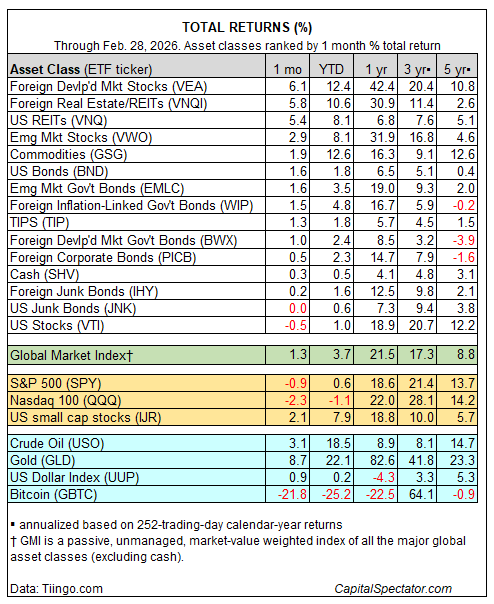
Foreign securities and US real estate investment trusts led a broad-based rally for the major asset classes in February, based on a set of ETF proxies. US stocks, however, didn’t participate in last month’s gains.
Foreign developed shares ex-US (VEA) led the field, posting a strong 6.1% gain in February–the ETF’s best monthly advance in more than two years. Year to date, this slice of global equities is up 12.4%, just behind the 2026 performance leader: a 12.6% rise for commodities (GSG).
US stocks (VTI) were the lone loser last month, edging down 0.5%. So far this year, US shares are up just 1.0%, which is close to the weakest performance for the major asset classes.

Notably, gains still prevail across the board for the trailing 1- and 3-year windows. But the outlook has suddenly turned cloudy in the wake of the US-Israel military strike on Iran, introducing a new phased of uncertainty for March and beyond.
Meanwhile, the Global Market Index (GMI) extended its bull run in February, rising 1.3%, marking the 11th straight monthly gain – the longest rally in nine years.

GMI is an unmanaged benchmark (maintained by CapitalSpectator.com) that holds all the major asset classes (except cash) in market-value weights via ETFs and represents a competitive benchmark for globally diversified, multi-asset-class portfolio strategies.
Learn To Use R For Portfolio Analysis
Quantitative Investment Portfolio Analytics In R:
An Introduction To R For Modeling Portfolio Risk and Return
By James Picerno
Author: James Picerno