
Momentum Factor Leads as Wall Street Bets on a Fragile Ceasefire
The iShares MSCI USA Momentum Factor ETF (MTUM) is leading the field by a wide margin for performance since the war began…8% gain since the close on Feb… The biggest loser since the war began is low volatility (USMV), which has declined 3…6% since Feb… Markets will be keenly focused on…
The tentative ceasefire between the US and Iran is holding as both governments prepare to meet for high‑stakes talks in Pakistan. The foundation for a peace deal may be wobbly, but the stock market is cheering: the S&P 500 Index closed on Thursday (Apr. 9) at its highest level in five weeks. Equity factors have also rallied, though results vary widely, with momentum posting the strongest gain based on a set of ETFs.
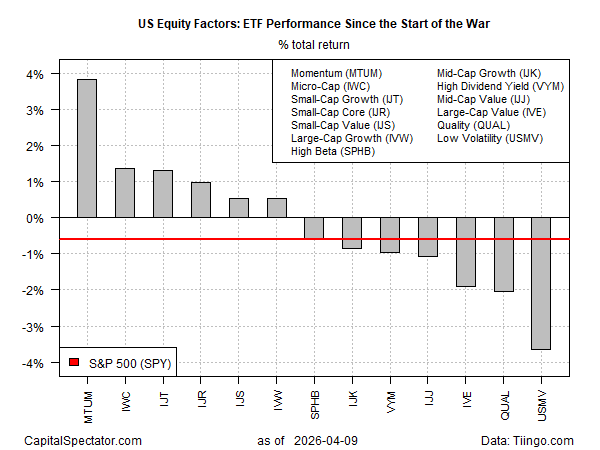
The iShares MSCI USA Momentum Factor ETF (MTUM) is leading the field by a wide margin for performance since the war began. The fund is the clear upside outlier, posting a 3.8% gain since the close on Feb. 27, the eve of the conflict’s start. Several other factors have rebounded, but none come close to momentum’s surge.

A number of equity factors remain underwater. The biggest loser since the war began is low volatility (USMV), which has declined 3.6%.
The broad stock market is also posting red ink for the war‑regime period. The SPDR S&P 500 ETF (SPY), despite a sharp rally in recent days, is down 0.6% since Feb. 27.
The revival of risk appetite remains precarious, hinging on the outcome of ceasefire negotiations that begin tomorrow. Markets will be keenly focused on the macroeconomic stakes, which are tied to control, stability, and predictability in the Strait of Hormuz—a chokepoint through which roughly a fifth of global energy supplies flows. At the center of these negotiations is the question of whether energy markets can avoid prolonged disruption—and whether the global economy can withstand the shock if they cannot.
“This is the most effective bargaining chip that Iran has got, and will always have,” said Martin Kelly, the head of advisory at EOS Risk Group, a consulting firm. “This is going to have a huge impact on global trade and the global economy.”
Is Recession Risk Rising? Monitor the outlook with a subscription to:
The US Business Cycle Risk Report
Author: James Picerno