
Novo Nordisk modernizes manufacturing process documents with Amazon Bedrock AgentCore
Every quality-relevant process step must be described, controlled, and validated through formal documentation… Keeping this documentation current and accurate is a core responsibility of the Manufacturing Technology team within the Tablet area, a responsibility that spans a large and diverse port…
Novo Nordisk (Novo) is one of the world’s leading global pharmaceutical companies, manufacturing medicines for chronic diseases such as diabetes and obesity, and delivering them to patients across many countries. Behind every product lies a manufacturing network that adheres to strict quality requirements. Every quality-relevant process step must be described, controlled, and validated through formal documentation. Keeping this documentation current and accurate is a core responsibility of the Manufacturing Technology team within the Tablet area, a responsibility that spans a large and diverse portfolio of controlled documents, including standard operating procedures, work instructions, forms, and training materials, across the global organization.
Managing this portfolio presents significant challenges. Document updates are frequent, driven by regulatory changes, process improvements, equipment modifications, and audit findings. Each update demands careful review, structured approval workflows, and timely communication to all affected stakeholders. With thousands of active documents spread across multiple divisions, departments, and product programs, tracking which documents are due for revision, pending approval, or require immediate attention becomes increasingly complex. Much of this oversight currently relies on manual processes and fragmented tracking methods such as spreadsheets or disconnected systems. These methods are time-consuming, error-prone, and difficult to scale. The result is a risk of outdated documentation remaining in circulation, delayed updates, and critical gaps in compliance visibility.
Beyond document management, there is a deeper knowledge challenge. Valuable manufacturing knowledge is distributed across many controlled documents, versions, sites, and product programs. Finding the right answer at the right time often depends on experienced individuals knowing where to look. This dependency on tribal knowledge creates bottlenecks that slow down decision-making and, ultimately, impact how quickly life-saving medicines reach patients.
To address these challenges, the Manufacturing Technology team within the Tablet area has embarked on developing an intelligent support system powered by agentic AI, deployed on AWS. The goal is to reduce lead times, improve documentation visibility, and make critical manufacturing knowledge more accessible, ultimately helping the organization move faster and serve more patients around the world. This post dives deep into the architecture and the key design decisions made to meet the high standards of accuracy and traceability required in a regulated pharmaceutical environment. The solution helped subject-matter experts (SMEs) complete work that used to take hours or days in minutes.
We also describe an AI process-intelligence assistant that can answer complex process questions with grounded, cited responses. The solution is built around a GraphRAG architecture, combining a knowledge graph with hybrid search to retrieve the most relevant and contextually accurate information. AI agents, built on a managed agent framework, coordinate the retrieval and response process end-to-end. A guided mode helps clarify ambiguous questions before a search is initiated, helping make responses more precise and defensible.
The challenge
Teams supporting manufacturing repeatedly answer variations of the same question: what does the process require, for this site, this product, and this equipment? Answering well requires four things at once:
- The right document out of a large corpus.
- The right version and lifecycle state (approved and effective, not draft or obsolete).
- The right scope (it actually applies to the site, product generation, and equipment).
- The relationships (which documents reference which, and what a change would impact).
Conventional keyword search returns documents, not answers, with no concept of scope, version, or relationship. A plain vector-based Retrieval Augmented Generation (RAG) system improves recall on natural-language questions but still struggles with exact identifiers (document numbers, equipment codes), with multi-hop relationship questions, and (most importantly for a regulated domain) with identifying when relevant content is not available. The team needed a system that treats structure and relationships as first-class, stays grounded in approved sources, and clarifies instead of guessing.
Solution overview
The assistant is built on a GraphRAG architecture: a knowledge graph in Amazon Neptune captures structure and relationships, and a hybrid search index in Amazon OpenSearch Serverless provides semantic and exact-match recall over document contents. The two stores are deliberately kept separate and bridged at query time rather than combined into a single engine. This is a common production GraphRAG pattern.
The reasoning layer runs on Amazon Bedrock AgentCore, a platform to build, connect, and optimize agents at scale with any framework or model. AgentCore was chosen for its managed agent runtime with built-in session isolation, native tool orchestration, and integrated AWS Identity and Access Management (IAM) and observability. This removes undifferentiated infrastructure work so the team could focus on the domain logic. The agent runtimes are built with the Strands Agents SDK and powered by Anthropic Claude models on Amazon Bedrock. Documents are processed through an ingestion pipeline that uses Amazon Bedrock Data Automation for multimodal parsing, orchestrated with AWS Step Functions and AWS Lambda. The stack is defined as infrastructure as code with the AWS Cloud Development Kit (AWS CDK).
At a high level, a question flows through the system like this:
- The query agent receives the question and, in guided mode, determines whether the scope is clear enough to answer well.
- If it is ambiguous, the agent asks a short, graph-grounded clarifying question (for example, which site or product generation applies) before searching.
- After scope is clear, hybrid search retrieves candidate passages, the graph expands from those results to add structure and relationships, and a reranking step sharpens precision.
- The agent composes an answer grounded in and cited to approved source documents, and is explicit when content is not available.
Architecture
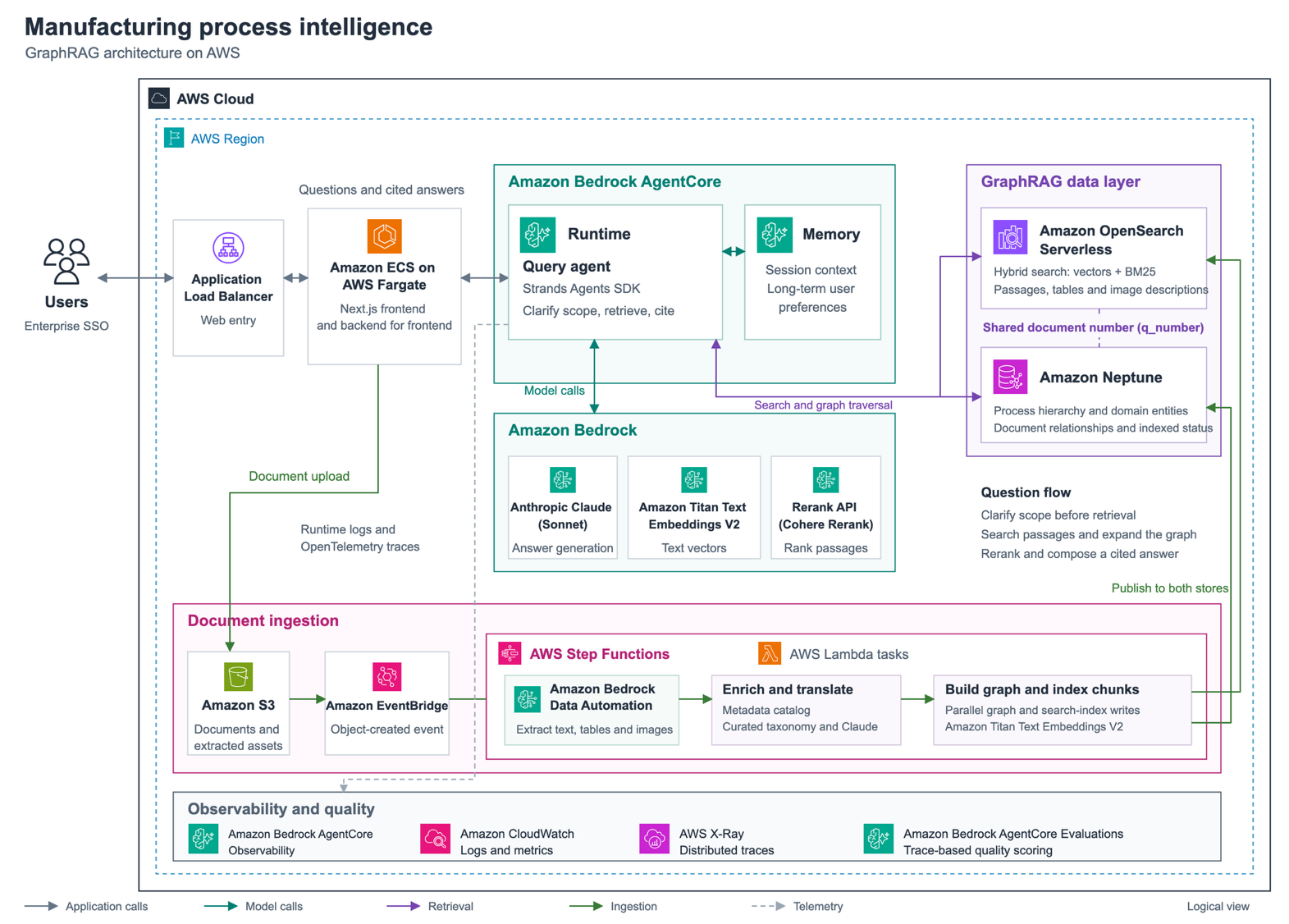
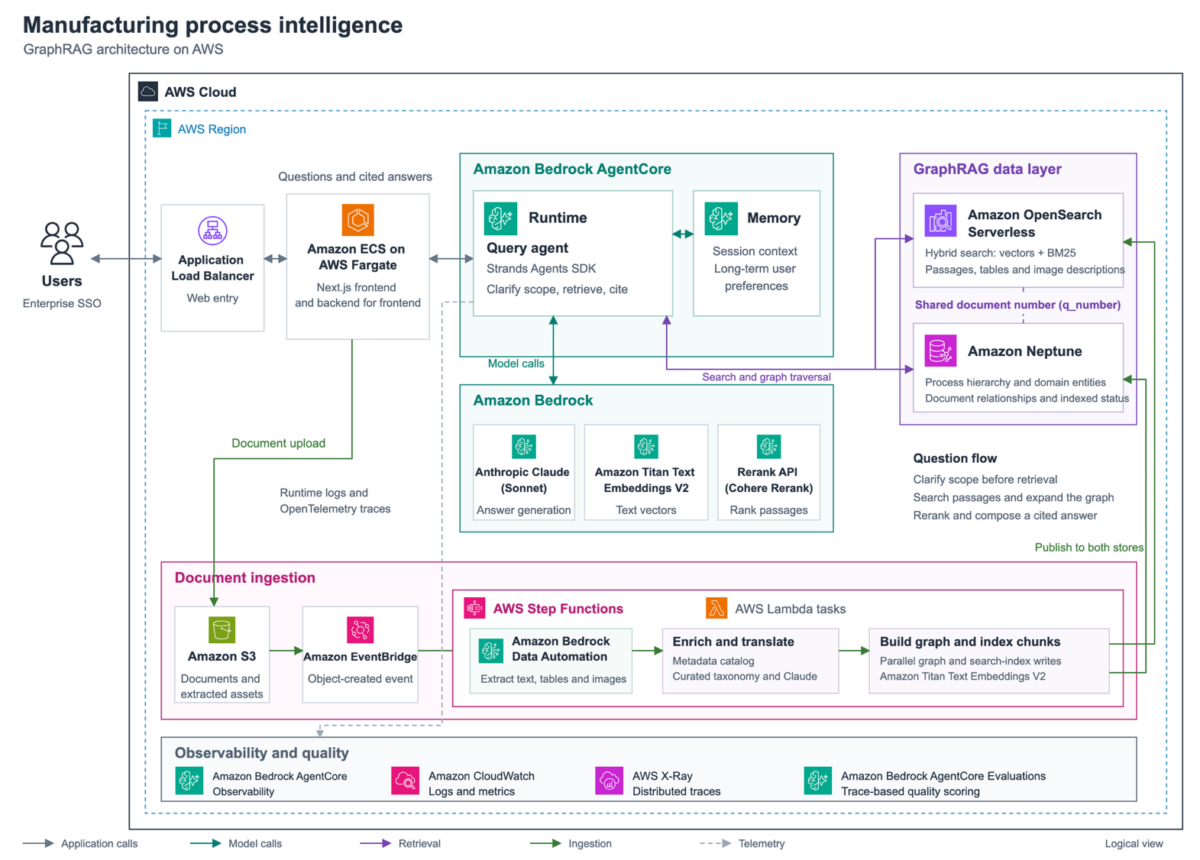
Figure 1: End-to-end architecture where a query agent on Amazon Bedrock AgentCore uses Amazon Bedrock for reasoning, embeddings, and reranking, with hybrid retrieval across Amazon OpenSearch Serverless and Amazon Neptune linked by shared document numbers. An event-driven, serverless ingestion pipeline populates both stores, while memory, observability, and evaluations support personalization, monitoring, and quality assessment
A two-layer taxonomy: Structure plus domain detail
The graph is organized around two complementary layers, which is what lets the assistant take into account where a document sits and what it is about.
High-level taxonomy: The process tree. The organization’s official process framework is modeled as a hierarchy of process nodes (roughly three levels, parent to child). Each controlled document is attached to the lowest applicable process level, so each onboarded document has a known place. This lets the assistant scope a question to a process area before retrieving anything, and automatically categorize newly ingested documents.
Low-level taxonomy: Domain entities. SMEs define the entities that make an answer correct or incorrect in manufacturing: sites, product generations, equipment, process steps, and similar attributes. These are modeled as first-class graph nodes linked to the documents that describe them, using a small set of unified relationship types rather than an ever-growing list of edge names.
Modeling both layers is what distinguishes a genuine GraphRAG system from two databases side by side. The document number on an OpenSearch passage is also a node in the graph, so a search hit is an immediate entry point into the graph’s structure with no fuzzy re-matching required. This chunk-to-graph bridge is a key design choice in the retrieval path.
Why a fixed, curated taxonomy (and why this is best practice)
Early GraphRAG work favored open-ended extraction, letting a language model discover entities with no fixed schema. This approach is powerful for open-ended sensemaking over sprawling text, but it is noisy, hard to maintain, and difficult to audit. Over the past couple of years, the consensus has shifted toward ontology-guided extraction using a predefined, domain-specific schema to guide the model, which improves accuracy and reliability for specialized corpora.
For regulated pharmaceutical manufacturing this is not a compromise, but the right default. The domain already has a real ontology, curated by experts, and a fixed schema with a human-in-the-loop promotion process for new entities supports the auditability the team needed in a regulated pharmaceutical environment. The design aligns with where much of the field has moved since early open-schema approaches, while making design decisions easier to explain to quality and audit stakeholders.
Retrieval: Hybrid search, graph expansion, and reranking
Each store covers the other’s blind spot:
- OpenSearch provides recall – Hybrid search combines dense vector similarity (Amazon Titan Text Embeddings) with lexical BM25 matching, fused with reciprocal rank fusion. Vector search captures meaning. And lexical matching catches the exact tokens that matter here: document numbers, equipment codes, and multilingual terminology.
- Neptune provides structure – Given the entities and documents search surfaced, the graph answers “what is connected, how, and how far”: neighboring documents, references, position in the hierarchy, and impact of a change, which is exactly what vector-only retrieval cannot do.
A common pattern is vector finds the seeds, the graph expands from them, and the reverse for relationship-first questions. A reranking stage (a cross-encoder through Amazon Bedrock Rerank) sits after fusion: it reads the question and each candidate passage together and reorders them, adding a precision pass on top of the cheaper recall stage before anything reaches the model.
Guided mode: Clarify before you retrieve
A distinctive part of the assistant is how it handles ambiguity. A question like “which samples are taken on the granulator?” has several correct answers depending on product generation, site, equipment, and batch size. Answering immediately risks a confident, wrong, out-of-scope response, which is the worst outcome in a regulated setting.
Guided mode inverts the usual RAG order: instead of retrieving first, the agent narrows scope through clarification first, then searches. This follows recent research on clarifying ambiguous questions before retrieval and on using a knowledge graph to supply the clarification options rather than letting the model invent them. It uses two classes of scope:
- A small, near-universal set of attributes (such as site and product generation) is asked directly and consistently for process-specific questions.
- Everything deeper: which equipment, which batch size, and attributes added over time. This is all derived from the graph at query time. A scope-resolution step matches the user’s term against real graph nodes, filters by what is already known, and, if more than one candidate remains, offers the attribute that genuinely distinguishes them, using only values that exist in the graph.
This keeps clarification options grounded in real data (designed to help reduce the risk of hallucinated options) and it scales: when experts add a new distinguishing attribute to the taxonomy, the assistant surfaces it automatically, without requiring changes to prompts or code.
Grounding and trust in a regulated environment
Accuracy here is defined narrowly and enforced deliberately:
- Explicit indexed state – A document can exist in the graph with metadata, relationships, and place in the hierarchy before its contents are searchable. A deterministic flag tracks whether a document’s content is indexed, so the assistant can distinguish between “I have this document’s contents” and “I only have its metadata,” rather than inferring availability from empty search results.
- Approved sources by default – Answers rely on approved and effective documents and the latest applicable version, unless the user explicitly asks for drafts or historical revisions.
- Anti-hallucination rules – Clarification options and cited claims are designed to come from actual tool results rather than the model’s own knowledge.
- Stated limitations – When retrieved material is missing or ambiguous, the assistant says so rather than filling the gap and flags when SME, quality, or regulatory review is needed.
An automated evaluation harness checks responses against these criteria: relevant-source selection, valid document status, latest applicable version, scope compliance, citation accuracy, and faithful preservation of requirement strength (must, should, or may) so behavior can be measured as the system evolves.
An intelligent search engine over a vault of millions of documents
The wider vault this solution sits on top of holds on the order of four million documents. At that scale, the problem is not a shortage of information but the near-impossibility of finding the exactly right, in-scope, current answer by hand. Traditional enterprise search returns long lists ranked by keyword overlap and leaves the hard work to the person asking. This includes deciding which result applies, which version is effective, and how documents relate.
This solution turns the vault into an intelligent, answer-first search engine, and the two-layer taxonomy is what makes that tractable at scale:
- The graph is the full map and the index is the searchable subset. Each onboarded document across all registered domains is placed in the graph with its metadata, relationships, and hierarchy position. This means the assistant can reason about where a document sits and how it connects, even for the millions whose contents are not yet indexed. Full-text contents are indexed for onboarded domains, added incrementally, and the assistant is explicit about which is which.
- Scope narrows the search space before retrieval. Because guided mode resolves site, product generation, process area, and equipment up front, a question is filtered to the small slice of the vault that can answer it. The system searches the few documents in scope, not millions. This helps keep answers precise as the corpus grows.
- Hybrid search plus graph expansion goes beyond keyword ranking, surfacing related documents, references, and hierarchy a ranked list would never reveal, and returning a grounded, cited answer (not ten blue links) while saying when content is unavailable.
The design is intended to scale with the vault rather than degrade as it grows: the larger and more interconnected the documentation, the more value the graph and scoping add.
Outcomes
Depending on the type of task an SME is doing (searching for an answer, updating a document, or adapting one for a new context), work that used to take hours or days is reduced to minutes. Beyond raw time saved, the solution changes what is practical to do at all:
- Navigate the group’s process landscape – Users can move across all three levels of the process taxonomy, spanning roughly four million documents and their many subprocesses through a single assistant that acts as both a search engine and a guide over the documentation, the process, and the organizational maps.
- Consolidate structured and unstructured data – Metadata, process hierarchy, and document contents are unified into one searchable knowledge graph, so information that used to live in separate systems can be queried together.
- Understand relationships between entities and documents – The graph helps users ask how documents, processes, equipment, sites, and products connect, including multi-hop questions that manual search cannot answer.
- Trace and validate references end to end – The solution can map a document’s full chain of references and flag where a document points at out-of-date or superseded material, surfacing integrity issues across the corpus rather than one document at a time.
- Extend to further AI and agentic capabilities – The same grounded foundation opens the door to capabilities like document generation, revision with impact analysis, and other agentic workflows reusing the same graph, retrieval, and guardrails rather than starting from scratch.
Just as important in a regulated setting, the assistant’s design to clarify scope and flag missing or ambiguous content helps reduce the risk of confident, out-of-scope answers, where the real cost of a mistake lies.
A collaborative delivery model
The Novo Manufacturing Technology team within the Tablet area collaborated with AWS to build this solution, with subject-matter experts and data and AI engineers working closely throughout. The taxonomy that makes the assistant accurate comes directly from the group’s domain experts. The retrieval and agent architecture was designed and iterated with AWS.
Building a prototype was key to getting the solution to go live. Rather than debating capabilities in the abstract, the team put a working system in front of subject-matter experts early. They tested it against real questions and used what they learned to sharpen the taxonomy, the retrieval path, and the guided-mode behavior. The prototype turned an ambitious idea into something people could try, critique, and trust. It also de-risked the architecture decisions before any broader rollout.
Conclusion
By combining a curated knowledge graph, hybrid search, and a clarify-before-retrieve agent on Amazon Bedrock AgentCore, the Novo Manufacturing Technology team within the Tablet area built a process-intelligence assistant that is fast where speed helps and grounded where accuracy matters. The design applies current GraphRAG patterns to regulated manufacturing: ontology-guided extraction, a bridged two-store retrieval path, graph-grounded disambiguation, and reranking. This turns a large documentation landscape into grounded, cited answers with room to extend to new domains.
To get started building your own agentic AI solution, explore Amazon Bedrock AgentCore for managed agent runtime, tool orchestration, and observability at scale. The agent runtimes in this post were built with the Strands Agents SDK, an open source, framework agnostic toolkit you can use with your own retrieval stack. For GraphRAG reference architectures using Amazon Neptune and Amazon OpenSearch Serverless, visit the AWS Architecture Center.
About the authors
Author: Elias Bedmar