
Q3 Growth Still Firm, But Fresh Headwinds Cloud the Outlook
Using the latest nowcasts suggests that the current Q3 estimate reflects a high degree of confidence that a strong run of economic activity is in the works…US economic activity remains on track to strengthen in the third quarter, based on the latest nowcasts compiled by The Capital Spe…
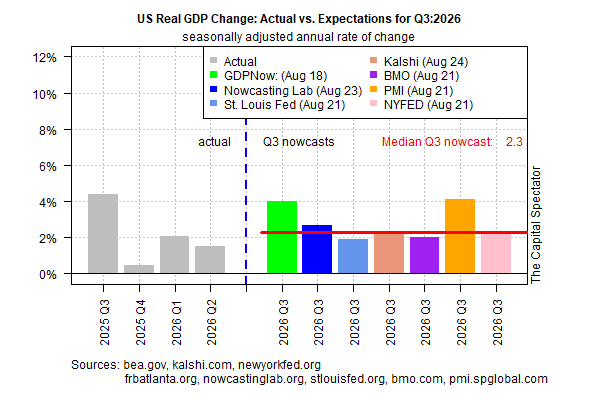
US economic activity remains on track to strengthen in the third quarter, based on the latest nowcasts compiled by The Capital Spectator. But the degree of the estimated rebound has softened lately amid recent hints that headwinds are building.
The good news is that our median 2.3% Q3 nowcast, drawn from inputs via several sources, continues to track well above the sluggish 1.5% annualized increase reported for Q2. Encouraging, but the government is scheduled to publish third-quarter data on Oct. 29, a reminder that a lot can happen to the economic profile over the next two months.
Using the latest nowcasts suggests that the current Q3 estimate reflects a high degree of confidence that a strong run of economic activity is in the works. All the estimates in the chart above are running above Q2’s 1.5% increase. The median 2.3% estimate represents a best guess at the moment based on available numbers.
One of the inputs—PMI survey data—highlights a robust pickup in growth in August, based on the US Composite PMI Output Index, a GDP proxy. “US business activity growth accelerated sharply for a second successive month in August to reach the fastest since April 2022,” S&P Global advised on Friday. “A surge in service-sector business activity helped offset a marked slowing of growth in the manufacturing sector.”
Yet the PMI report also highlights a possible source of vulnerability for the economy in the months ahead. To the extent that economic activity is becoming more reliant on consumer spending, the ongoing rise in Treasury yields could pressure households by lifting borrowing costs and squeezing discretionary income.
One sign of that risk: retail sales posted a 0.6% drop in July—the first monthly decline since January and the deepest in over a year. The slowing year-over-year trend in the Redbook Index, a measure of same-store sales, may also reflect softening demand on Main Street.
Another possible warning that economic activity is downshifting: the Dallas Fed’s Weekly Economic Index (WEI), continues to ease, based on the 10-period moving average. The latest data point still equates with a 2.6% year-over-year increase in GDP through Aug. 15, which is modestly above the one-year rise through Q2, but the tide appears to be turning.
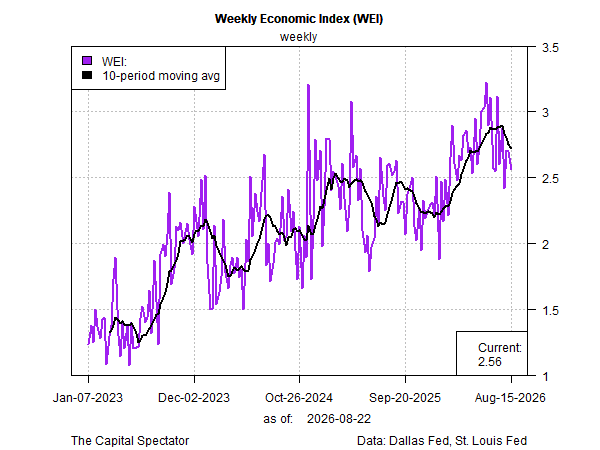
WEI data can be noisy from week to week, which suggests the 10-period average offers a more reliable measure of the bias in economic activity. On that basis, the ongoing deceleration in growth, although mild so far, could be an early sign that a recovery in Q3 may be short-lived.
A key risk factor in the weeks ahead is how the bond market evolves. The recent rise in Treasury yields suggests a possible headwind brewing for the economy. The 10-year yield, for example, closed at 4.74% on Friday, marking a rebound to just a few ticks below a one-year-plus high reached a few weeks earlier. If yields continue to rise from current levels, consumer spending will come under more pressure—a risk that will come into sharper focus in Q4.
Is Recession Risk Rising? Monitor the outlook with a subscription to:
The US Business Cycle Risk Report
Author: James Picerno