

Rising Misery Index Signals Mounting Economic Pressure
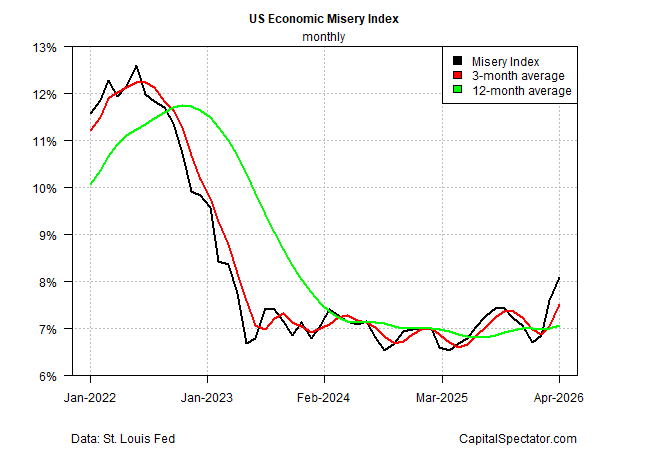
April’s sum of the one‑year change in the consumer price index and the jobless rate rose to 8… The Federal Reserve pays more attention to core inflation metrics, which tend to provide a more robust measure of inflation’s trend compared to noisy headline indexes… In 2021 and 2022, the inde…
Economic headwinds continue to reverberate from the conflict in the Middle East, but the US economy has proven relatively resilient in the wake of this macro shock. How long that resilience lasts is unclear, but the pressures are building. That’s a worrisome sign as the stalemate between the US and Iran continues and energy exports from the Gulf remain blocked.
A useful proxy for estimating the potential for economic fallout is the so‑called Misery Index, which combines the inflation rate with the unemployment rate—a measure of the economic well‑being of the average consumer. By this benchmark, the war’s blowback is rising. April’s sum of the one‑year change in the consumer price index and the jobless rate rose to 8.1%, the highest in three years.
All of the recent upturn is due to hotter inflation over the past two months. The unemployment rate, by contrast, has remained steady at a modest 4.4%. Inflation appears likely to trend higher as the supply‑side energy shock continues, and so even a modest increase in the jobless rate could intensify the Misery Index’s increase this summer.
For now, another bullet has been dodged this week. President Trump said Monday that he had canceled what he described as a planned US strike on Iran scheduled for Tuesday. He explained that he halted the operation because “serious negotiations” were underway toward a peace agreement that he claimed would satisfy the United States and its Middle Eastern partners. Yet the very fact that a military attack was being prepared—and called off only at the last moment—underscores how far the two countries remain from any durable resolution.
Unsurprisingly, inflation is expected to trend higher in the upcoming report for May. The Cleveland Fed’s nowcast indicates that headline CPI will top 4% for the annual change for this month. Assuming the jobless rate holds steady, the CPI nowcast points to another rise in the Misery Index for May.
Optimists can point to core CPI, which has increased at a much softer pace, ticking up to 2.7% for the year through last month. The Federal Reserve pays more attention to core inflation metrics, which tend to provide a more robust measure of inflation’s trend compared to noisy headline indexes.
The problem is that while core CPI gives the Fed space to maintain a wait‑and‑see position on whether to tighten monetary policy, consumers are already feeling the pain of the war’s effects. In today’s hyper‑charged political climate, it’s an open question whether central bankers will remain immune to events on Main Street.
The recent history of the Misery Index suggests there are limits to that immunity. In 2021 and 2022, the index was soaring, peaking at 12.6% in May 2022, two months after the Fed started hiking interest rates.
The current Misery Index is still well below the previous peak, but the gap is narrowing, and the geopolitical news from the Gulf suggests more of the same is coming in the near term. History doesn’t repeat, but it’s getting easier to argue that it’s starting to rhyme… again.
Is Recession Risk Rising? Monitor the outlook with a subscription to:
The US Business Cycle Risk Report
Author: James Picerno