

Risk-On Returns, but Cracks Still Show Beneath the Surface
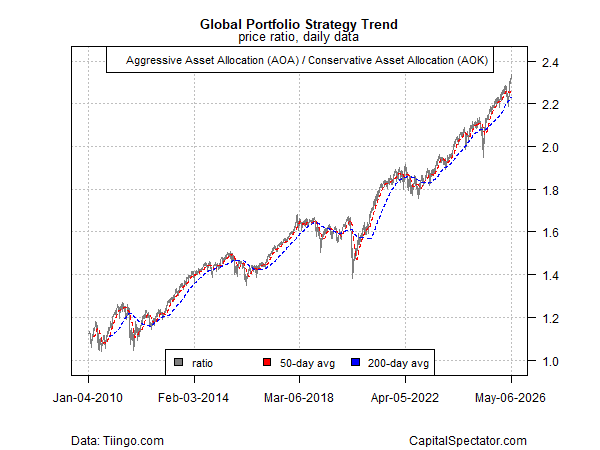
A big‑picture measure of the trend in global asset allocation has rebounded to a positive bias, based on the ratio of two global asset‑allocation ETFs: an aggressive strategy (AOA) versus its conservative counterpart (AOK)… After taking a hit in April, the ratio has recovered and climbed…
A few days before the war with Iran began on Feb. 28, The Capital Spectator reported that “Bullish Momentum Holds Firm in Global Asset Allocation,” based on a set of ETFs targeting multi-asset strategies. The risk‑on profile quickly evaporated as investors ran for cover in the wake of hostilities. But more than two months later, risk appetite is looking resilient once more.
A big‑picture measure of the trend in global asset allocation has rebounded to a positive bias, based on the ratio of two global asset‑allocation ETFs: an aggressive strategy (AOA) versus its conservative counterpart (AOK). After taking a hit in April, the ratio has recovered and climbed to a new high in yesterday’s trading (May 6).
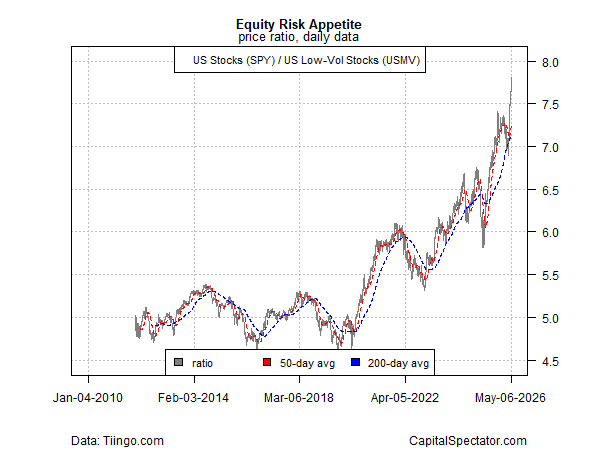
The recovery in risk‑on signaling is even stronger for US equities, based on the ratio of a conventional measure of the U.S. stock market (SPY) to a low‑volatility counterpart (USMV), which serves as a relatively conservative proxy for holding American shares. This ratio has surged in recent weeks, reaching a new high yesterday.
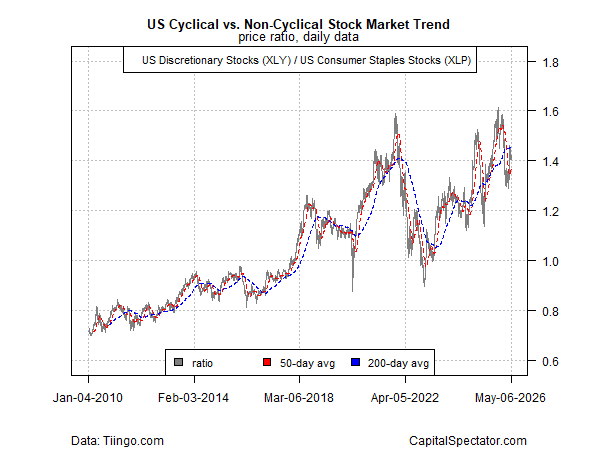
A possible warning sign that the rebound in animal spirits is driven more by speculation than by confidence in the business cycle: the ratio of US cyclical stocks (XLY) to defensive shares (XLP) remains stuck in a middling range, closing yesterday’s session well below where it began the year.
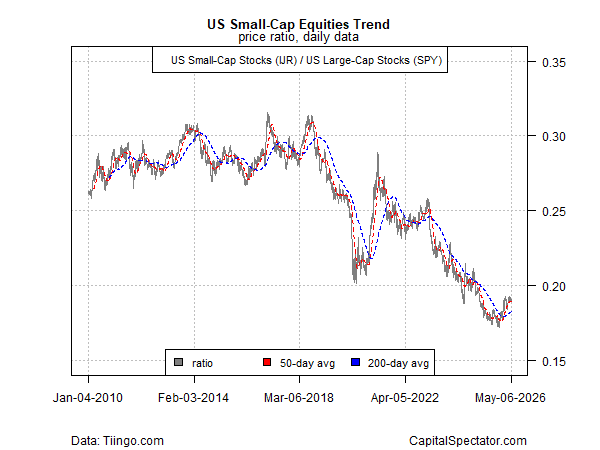
Another area not participating in the risk‑on revival, at least in relative terms, is small‑cap stocks. The ratio of small caps (IJR) to large caps (SPY) is near its lowest level of the year following the runup late last year.
Meanwhile, the late‑2025 revival of value stocks (IWD) relative to growth shares (IWF) has faltered since the war began and has yet to recover.
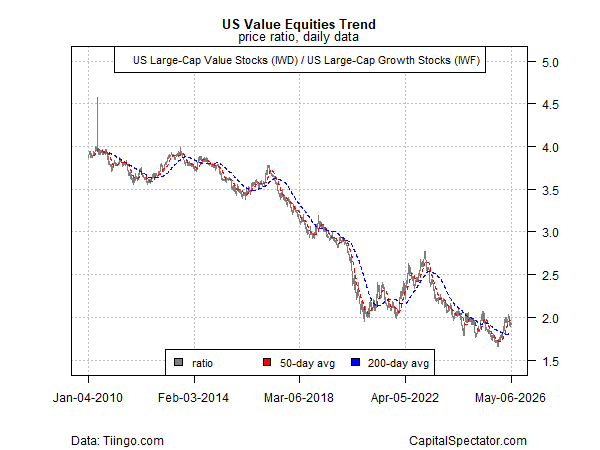
From a top‑down perspective, the case for risk‑on once again looks solid. Beneath the surface, however, the outlook is mixed. That’s hardly surprising, given the uncertainty hanging over the global economy due to the ongoing Middle East turmoil. But from a global asset‑allocation perspective, the crowd is betting that any turbulence will be short‑lived.

Author: James Picerno