

Trump’s Strike Freeze Lifts Markets, but the Calm Looks Fragile
Meanwhile, markets are on the lookout for signs that the energy shock unleashed by the war will lift inflation for an extended period… Although formal inflation data arrives with a lag, several real time benchmarks are hinting a elevated pricing pressure… Their global inflation index, which …
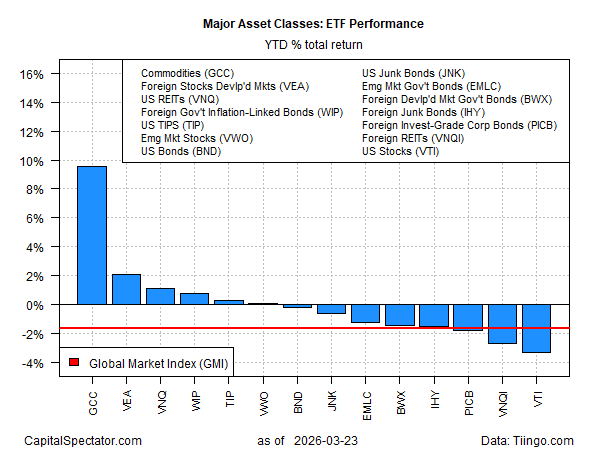
President Trump’s announcement of a halt in the strikes on Iranian infrastructure sparked a rise in risk assets on Monday (Mar. 23). It’s unclear if this is a temporary lull or a diplomatic opening that leads to a ceasefire, but risk assets found some breathing room yesterday. Commodities are still the strongest year-to-date performer for the major asset classes, but 2026 results are a bit less lopsided through yesterday’s close, based on a set of ETFs.
Raw materials continue to dominate this year, but the outperformance has become less extreme in recent days. WisdomTree Commodity ETF (GCC) is up 9.6% in 2026 – a strong run, although down sharply from the near-16% peak year-to-date performance set earlier this month.
After commodities, the best performer: foreign stocks in developed markets ex-US (VEA), posting a 2.1% gain, followed by US real estate investment trusts (VNQ), which are up 1.1%. US stocks (VTI), by contrast, are down 3.3% — the deepest year-to-loss for the major asset classes so far this year.

The path ahead is still fraught due to a truckload of uncertainty. The main item on the agenda: Will a diplomatic solution emerge to end the war in Iran? There’s a glimmer of optimism following Trump’s announcement, but the fighting continues and Iran has denied that any substantiative negotiations are happening. Fake or not, the news triggered a hefty decline in oil prices on Monday. The US benchmark fell below $90 a barrel, the lowest in nearly two weeks.

Even if the war ended today, energy infrastructure in the Persian Gulf region must be repaired to boost oil and natural gas exports from the Middle East to ease the supply crunch. “It will take some time to come back to the normal days we had before the war was started,” said Fatih Birol, the executive director of International Energy Agency.
Meanwhile, markets are on the lookout for signs that the energy shock unleashed by the war will lift inflation for an extended period. Although formal inflation data arrives with a lag, several real time benchmarks are hinting a elevated pricing pressure. The Economist reports:
Alternative Macro Signals, a consultancy, analyses millions of news articles. Their global inflation index, which has proved to be a useful predictor of official numbers, has recently risen sharply. If historical patterns hold, by July monthly global inflation could be above 0.6%. That is more than 7% on an annualized basis.Alternative Macro Signals is not the only worrying datapoint. Truflation, a consultancy, analyses prices in real time from a wide variety of sources. Its figures suggest that this month American year-on-year goods inflation has jumped from less than 1% to nearly 3.5%. This was almost entirely the result of rising petrol prices.
Hotter inflation is a near-term risk, but the jump is still expected to be temporary, based on the Treasury market’s implied forecast via the yield spread for the nominal 5-year yield less its inflation-indexed counterpart. The current estimate is 2.53%, which is modestly below the peaks over the past year.

Despite the relative calm for the Treasury market’s outlook, it’s premature to dismiss the potential for an inflation shock of some duration. Despite Trump’s announcement, the war continues, which means that the further upside inflation pressure may be brewing — a risk that markets have yet to fully price in.
“What makes this a fraught but intense moment is nobody can tell us what is going to happen on the ground in the conflict in the Middle East, and how long that lasts,” Chicago Federal Reserve President Austan Goolsbee said on Monday.
Until there’s a strong case for arguing otherwise, the near-term outlook for risk assets still looks wobbly.

Author: James Picerno