

US–Iran Ceasefire Takes Hold, as Fragile Peace Looms
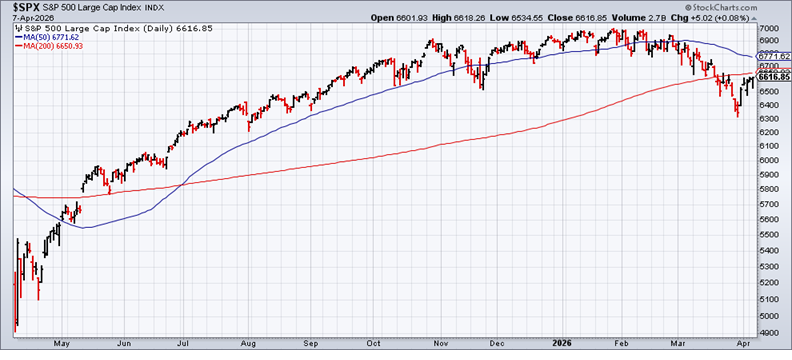
The peace may be fragile, but markets are already cheering this morning…Let’s start with the stock market…One of the many technical profiles of markets I’ll be monitoring is this variation of my estimate of overbought-oversold conditions for the S&P… The risk appetit…
The two-week ceasefire announced by the US and Iran on Tuesday is welcome news, but deciding if the threat of war has truly passed will take time. The peace may be fragile, but markets are already cheering this morning. The true test will unfold over the coming weeks. Here are some of the indicators I’ll be watching for determining if the worst has passed.
Let’s start with the stock market. The S&P 500 Index has already been rallying off its recent low, and the recovery is likely to continue today.

One of the many technical profiles of markets I’ll be monitoring is this variation of my estimate of overbought-oversold conditions for the S&P. As of yesterday’s close, hints of recovery have emerged in recent days.

The performance of Treasury yields will be even more critical this week and beyond. The 10-year yield, for example, has pulled back from its recent runup. The risk appetite’s recovery for the near term will rely in no small degree on the bond market remaining calm. The key variable is whether the expected rebound in war-related headline inflation stays modest and short-lived.

Economic risk will come into sharper focus in the weeks ahead. The Atlanta Fed’s GDPNow model continues to downgrade the expected rebound in output for the first quarter. Yesterday’s nowcast was downgraded to a soft 1.3% for the upcoming Q1 report (due on Apr. 30). That still marks a recovery from Q4’s stall-speed 0.7% gain, but the current Q1 estimate suggests that the war’s effects will remain a headwind for an already struggling economy in Q2.
Inflation will also remain a critical factor for market behavior in the weeks ahead. The concern is that repairing damaged energy infrastructure in the Middle East will take months, perhaps years in some cases, and so relief for headline measures of inflation will arrive slowly.
The initial reaction of US consumers on the inflation outlook since the war started raises a warning flag. Median inflation expectations rose to an expected 3.4% annual pace for the year-ahead outlook, according to the New York Fed’s survey. The question is whether the bump is temporary, or the start of an extended reflationary run for the public’s perception. The Federal Reserve will be closely watching as it determines how or if to adjust its target interest rate in the months ahead.
Speaking of the Fed, keep an eye on how the policy-sensitive 2-year yield evolves from current levels. As I noted yesterday, this key rate has recently shot above the median Fed funds rate, signaling that the market is pricing in a modest rate hike. The futures market disagrees, but sentiment in Treasuries still matters and so the 2-year yield’s path ahead could play a key role in determining the risk appetite for the near term.

The main test will be the durability of the ceasefire. Talks between the US and Iran are scheduled to start on Friday in Islamabad to discuss Iran’s 10-point plan, which President Trump said was a “workable basis” for negotiations in a social media post. Meanwhile, Iran’s foreign minister Abbas Araghchi announced that Tehran would allow two weeks of “safe passage” of energy shipments through the Strait of Hormuz.
It’s unclear how much give and take each side will tolerate in the upcoming talks. For now, a precarious peace prevails.
“Markets will be able to breathe for at least a few days,” said Michael Alfaro, chief investment officer at Gallo Partners, a US hedge fund.
There’s still no quick fix for the energy shock, even if the war is truly over.
“Presuming traffic begins to flow through Hormuz, trade flow normalization will take months, not weeks,” predicts Zhuwei Wang, director of research and analysis at S&P Global Energy.
The good news is that the repair process, for infrastructure and sentiment, can start today. It’s a recovery… if Washington and Tehran can keep it.

Author: James Picerno