

Will Markets React To The US Investigation Of Fed’s Powell?
On Sunday evening, Federal Reserve Chair Jerome Powell said in a statement that the Department of Justice is investigating him in a criminal probe related to the $2…Asked about the investigation of Powell, Trump told NBC News: “I don’t know anything about it…”The question, o…
Another week, and another new risk factor to digest. This time it’s a sharp escalation in President Donald Trump’s struggle with the Federal Reserve, which critics charge is a thinly-veiled effort to force the central bank to lower interest rates.
On Sunday evening, Federal Reserve Chair Jerome Powell said in a statement that the Department of Justice is investigating him in a criminal probe related to the $2.5 billion renovation to the central bank’s headquarters in Washington, DC.
Asked about the investigation of Powell, Trump told NBC News: “I don’t know anything about it.”
The question, once again: Will markets react? Or, will recent history repeat, in which case the crowd will look through the news and keep the bull market humming?
Meantime, Fed Chair Jerome Powell has come out swinging. In a two-minute video statement released Sunday evening, he framed the investigation as a new tactic by President Trump in reaction to the Fed’s refusal to cut interest rates quickly, to a level that the president demands.
“The threat of criminal charges is a consequence of the Federal Reserve setting interest rates based on our best assessment of what will serve the public, rather than following the preferences of the President,” Powell said in his statement. “This is about whether the Fed will be able to continue to set interest rates based on evidence and economic conditions — or whether instead monetary policy will be directed by political pressure or intimidation.”
Trading this week will be closely watched and viewed through the lens of the Fed investigation. For some analysts, the news casts a pall over the near-term outlook for the risk appetite.
“We expect the dollar, bonds and stocks to all fall in Monday trading in a sell-America trade similar to that in April last year at the peak of the tariff shock and earlier threat to Powell’s position as Fed chair, with global investors applying a higher risk premium to US assets,” Krishna Guha, an analyst at Evercore ISI, wrote to clients in a note.
Blake Gwinn, head of US rates strategy at RBC Capital Markets, said: “Markets will start to price in greater inflation expectations, inflation risk premium, and term premium if the Fed’s independence comes under further attack. We don’t appear to have hit it yet, but every action is another step closer to it.”
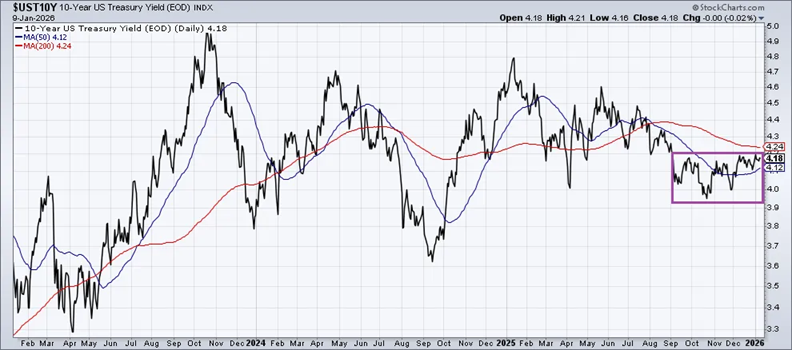
The crucial variable is how Treasury yields react, or don’t. As I noted in this week’s edition of The ETF Portfolio Strategist, “Yields are still trading in a relatively low range. When/if that changes, markets writ large could reassess the risk appetite, but such an attitude adjustment doesn’t look near.”
That was written before Powell’s statement was released. Has the yield calculus changed in the last several hours? We’re about to find out.
At Friday’s close, the US 10-year Treasury yield was still trading in a tight range that’s prevailed since September. Traders will be watching to see if it breaks higher this week and breaches the 4.20% mark that’s been a ceiling in recent months.

Keep an eye on the 30-year yield, too, the most inflation-sensitive rate. Will the moderate upturn in this yield since October continue this week?

If the playbook of 2025 holds, markets will suffer a run of tubulence and then recover. It’s any one’s guess if that script gets a reboot in this year’s sequel. But to the extent that markets will drop clues about where we’re heading, the directional bias of Treasury yields, or the lack thereof, is on my short list as critical factors for setting (or re-setting) the mood on Wall Street.
Is Recession Risk Rising? Monitor the outlook with a subscription to:
The US Business Cycle Risk Report
Author: James Picerno